|
Shandelee Stories
After the second hay cutting on our farm, my father would then
open-up the hayfields to the cattle, allowing them to taste the fresh
shoots of green grass before the autumn's first killing frost. Before
allowing the beasts onto the fields, however, the fencing needed to be
checked and repaired where necessary. I was assisting my father in this
chore one evening in September of 1959, when, overhead, we could hear the
drone of a small airplane. Not paying particularly close attention to the
sound, we continued working on the fence when suddenly, the noise stopped.
We noted the abrupt silence amongst ourselves but came up with rational
reasoning for the evening's sudden calm; pilots who were in training from
the Livingston Manor Airport often were told to cut their engines for
practice or else a plane-jockey was thrill-flying. We continued with our
chore.
"The rugged six-foot tunnel worker plunged to his death on Shandelee
Mountain in a two-seater Piper Cub at about 6:20 last Thursday evening. He
was identified as George Berggeren, 26, a Sidney Center native. He has
been rooming for the past ten months with the Joseph Griffin family of
Livingston Manor. He worked for the West Delaware Tunnel Construction at
Shaft 6.
"Chauncey Turk, first to arrive at the scene of the accident, states that
Mr. Berggeren had made a left turn over his house, which is near the top
of the mountain, straightened out, leveling off and with his
motor still running, crashed less than a quarter of a mile down the hill
and searching the nearby woods, found the wreckage a short distance from
the road.
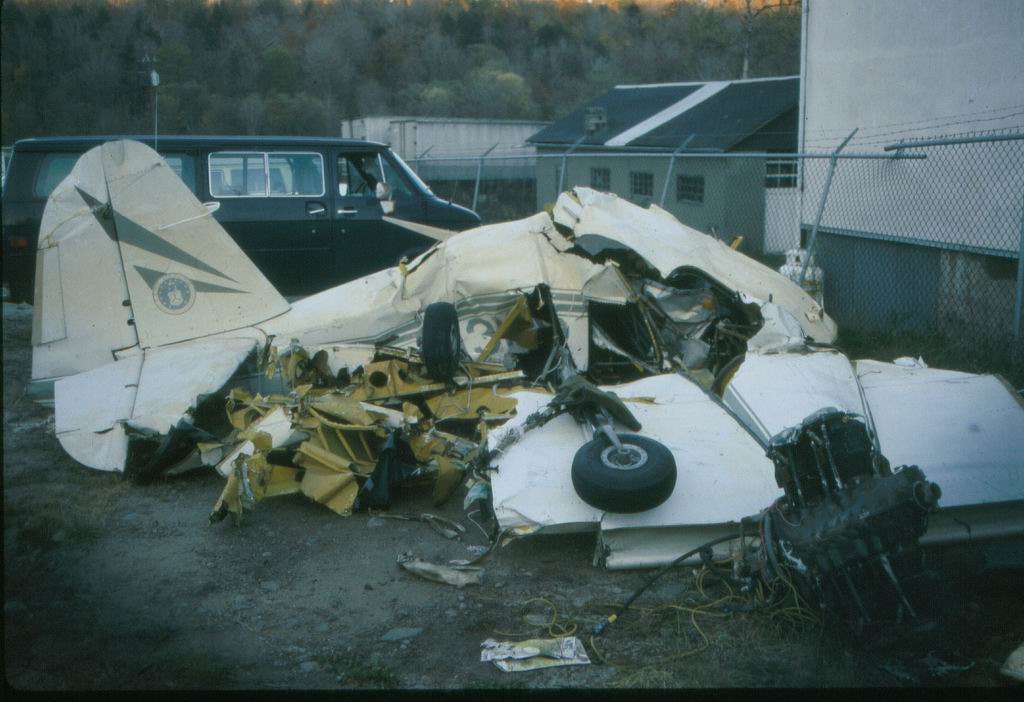
"The first 3/4 of the plane was completely demolished, the only thing that
would identify it as a plane was the tail assembly and what remained of
the wings. The remains of the motor had been jammed back into the cockpit
area."
September 24, 1959
Livingston Manor Times
The story was often told that they carried the remains of Mr. Berggeren,
all six-foot of him, away from the scene of the accident in a bushel
basket.
fred
Thanks Fred for that story. I'd heard talk about a
plane coming down on Shandelee Mountain but most people seem to think it
went into Sand Pond. My partner and I own the old Lake Rest Hotel site at
the top of the hill - any idea exactly where the plane would have landed?
We've already been told about the young lad who lost his life after the
hotel burned. Many ghosts on the mountain it seems.
Paul
The plane went down a few hundred feet off of the
Shandelee Road, a little less than two miles from Lake Rest, towards the
Manor, on the left side and where the road flattens out below the Temple
Road turn-off. There is a house now in the general vicinity, the house is
about 100 yards from the road.
September 24, 1959
Livingston Manor Times
********************
Shandelee Stories
Mark Pressburger had the holiday week-end all planned.
He would leave his Englewood home Wednesday afternoon and join
his wife, Priscilla, up at the Catskill resort, the Concord
Hotel, and together would observe the high holy week of Rosh
Hashanah. Instead of fighting afternoon traffic escaping the
city's workday, he would pilot his plane, a twin-engine Piper
Aztec, from Teterboro Airport to the local airport at Sullivan
County where he would meet his wife.
The experienced pilot took off from the New Jersey airport that
afternoon, September 19th, 1990. Though overcast skies blanketed
the area, no threat of inclement weather was in the immediate
forecast, allowing Pressburger to pilot his plane using visual
flight control. But weather conditions can be radically
different in higher terrain, as the pilot soon discovered as he
climbed over the higher, more rugged landscape of the southern
Catskills. Entering Sullivan County airspace, he encountered a
much lower cloud ceiling. Forced to fly in the whiteness of
thick fog and the relentless drizzle, he switched from visual
flight to the plane's instruments for finding his destination.
On the approach, he was to find the airport's beacon light, that
once locked in, would guide him on his approach toward the
runway. For whatever reason, he failed in his first attempt
finding this marker and circled overhead to make another pass to
link up with the airport.
The Catskill Mountains are bounded to the
east by escarpments, where the more rugged peaks have
geologically resisted eons of erosion to form a wall of forested
hills, most notable being the steep hillside that rim the
Husdson Valley. On the western side of the Catskills, not as
dramatic as to the east, is a less pronounced, west-facing,
elevated ridge that goes from the Tennanah Lake section to
Walnut Mountain, just outside of Liberty, including Shandelee.
The change in elevation from the ridge's height to the lower,
rolling countryside is spread over a wide belt, and though not
as obvious, the ridge's height looms up to 1,000 feet above the
narrow valleys to the west and, more importantly, the airport
thirteen miles away. Though it is not known, perhaps
Pressburger's instruments were not calibrated for the
changes in elevation and if flight charts were in the cockpit,
he probably was preoccupied, blindly maneuvering the plane now
floundering in the clouds.
The plane, an older Piper model and being over thirty years old,
roared over the residents and homes, just above the tree tops as
it passed over Shandelee in the thick fog. Making a swing
towards the south to find the airport's beacon, it clipped a
tree-top along the northern shoreline of Sand Pond, ripping off
the nose-wheel from the fuselage, spewing articles from the
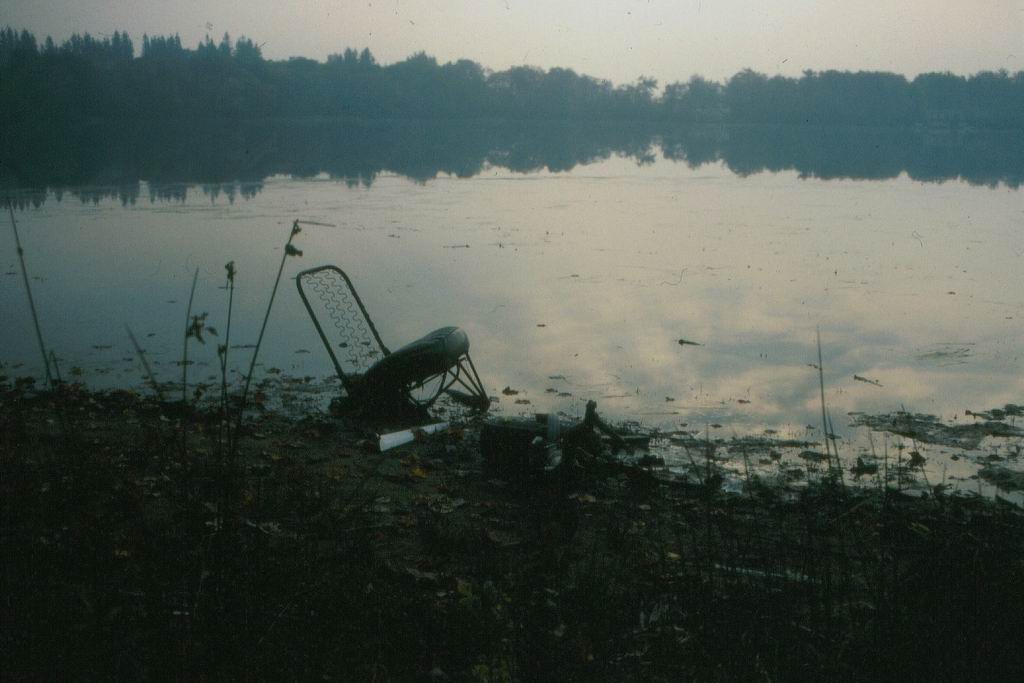
cockpit along the shore and into the lake. The engines continued
to power the aircraft out over the lake, now losing what little
altitude it had, until the plane slammed into the surface of the
lake, a quarter mile from its initial impact, ripping the
engines off of the wings. Pressburger was ejected from the plane
upon impact, both pilot and plane sinking to the lake's murky
depths below.
Fred
**********
Shandelee Stories
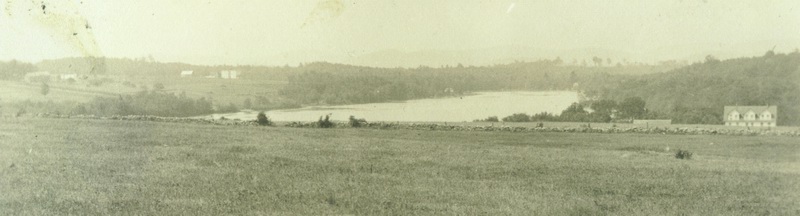
Since the introduction of bass to Sand Pond,
sportsmen have sought this prize fish, known for its gamey
fight once upon the hook. Known favorite haunts under the
lake's surface for these finned creatures are secretly
kept by anglers, who go to great lengths to hide their
location's whereabouts. Bass fishermen have continually
relied on various techniques, equipment and knowledge of
the fish's habits to seek the upper hand in landing the
trophy. Recently added to the bass master's arsenal is a
"fish-finder', a portable, hand-held device that is able,
through the use of sonar, to scan the under-surface waters
and locate individual or schools of fish. The secrets of
the lake's depths are now visualized on the small screen,
the mysterious hiding places revealed to the bass master
floating above in search of bass treasures from the deep.

A couple of bass fishermen were out on
the lake as the early morning's mist rose from its surface
when recovery operations for the Pressburger plane resumed
the morning of September 20th. Rescuers discontinued the
search the previous evening as darkness set in but now
returned with divers from three local fire departments and
the office of the Sullivan County Sheriff. Overhead, a
State Police helicopter circled the lake, following the
plume of oil and gasoline on the water's surface, in hopes
of seeing the submerged aircraft from the air, but without
any luck. Divers probed the murky bottom, each movement
riling up silt and diminishing what was already limited
visibility. By chance, just before noon, after three hours
of underwater searching, they stumbled upon Pressburger's
body, half buried into the silt, in 38 feet of water. The
plane's location, though, was still a mystery.

Officials from the National
Transportation Safety Board were in hopes of locating the
wreckage by honing in on the plane's emergency transmitter
but were unsuccessful in this attempt. Finally, a bass
master's hand-held "fish-finder" was put to use, and the
hidden mystery along the lake's bottom, half concealed in
mud, was uncovered as the wreckage, broken into three
pieces, was finally located, only about twenty feet away
from where the unfortunate pilot was found. Throughout the
history of Sand Pond, its waters have swallowed up horses,
sleighs, trucks, one-arm bandits and the occasional
swimmer, but now the biggest "trophy" of all, during the
lake's grandest fishing expedition, has been found. Now,
as with bass, the challenge was "reeling" the aircraft in.
|
|
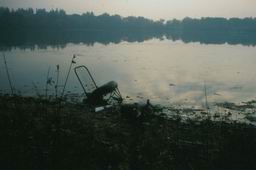
Divers attached buoys to the wreckage, pin-pointing the
location of the wrecked plane as it sat forty feet beneath the lake's
surface. For four weeks they bobbed about on the lake's waves as the
National Transportation Safety Board, in charge of the plane's recovery,
dealt with other more pressing emergencies along with the problem of
getting a salvage crew together at the site. Finally, during the aumtmn
chill of late October, the recovery effort began as divers attached
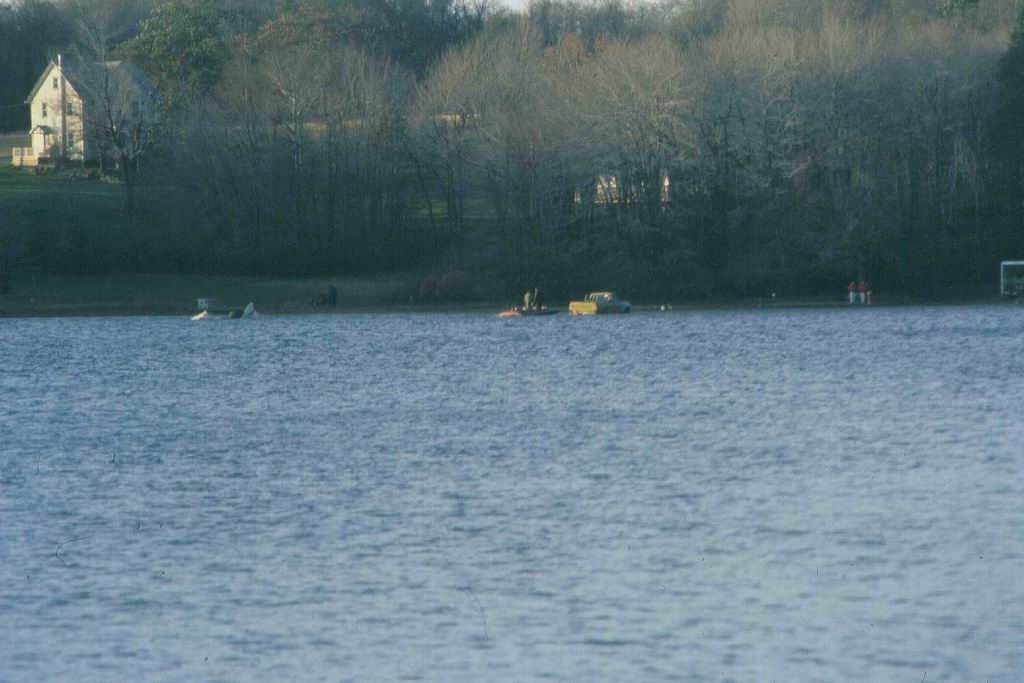
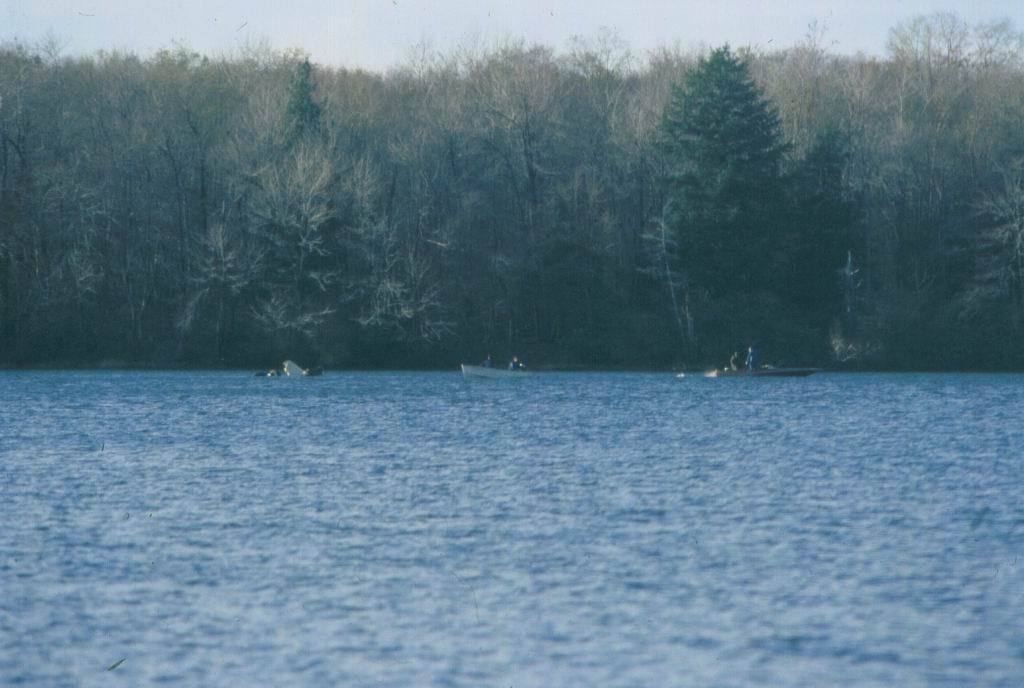
floatation collars on the wreckage. When inflated, the plane, minus one of
its engines, was lifted from its watery grave. Once on the surface, at the
point where it crashed into the lake, it was slowly towed by power-boats
to the lake's northern shore, near the location where it first clipped the
tree-tops. It was a long process, taking most of the day and it was not
until late afternoon when the plane finally reached the shoreline, winched
onto the awaiting box truck and carted away.
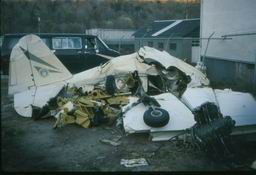
The Federal Aviation Administration was assigned the
task of investigating the accident. Pressburger was dead before being
submerged into the water, the autopsy concluded, receiving massive and
fatal head injuries when he was ejected from the aircraft. The remains of
the plane were to be hauled to a hanger at the Sullivan County airport,
ironically its original destination for that September evening, where it
was to be reassembled and inspected. Until arrangements were made,
however, the crumpled mass of plastic and metal that was once an aircraft
was deposited at Sam's salvage yard, depository of mangled vehicles
collected by the Liberty, New York, tow-truck operator. Apparently there
was no urgency into the investigation of the mishap, for it was at the
yard for well over a couple of years. The plane's location being visible
from the road, it originally caught the attention of those passing by, but
eventually became just another wreck in the crowd.
Today, the fishing is as good as ever on Sand Pond, the
bass still successfully matching wits with the current technologically
armed anglers. As more and more of these nimrods rely on "fish-finders" in
search of their prey, the lakes depths are now being continuously probed.
As this battle between man and fish rages on, according to stories
recently told, there is one particular location, near the middle of the
lake, where an unexplained blip sometimes shows up on the "fish-finder's"
hand-held screen. They say that the size of the screen's apparition is
much too large for even the largest of the lake's bass. Perhaps the
remaining Piper engine, that was left during the recovery, or another
piece of the wreckage that was left could explain the image.
fred
**********
Shandelee Stories
Many stories persist about the fogs of Shandelee. The most
publicized story, of course, comes from our legendary Johnny Darling when
he tells about the time when he was shingling his roof during a Shandelee
fog. When the fog lifted, he had found out that he had actually shingled
over the fog and extended his roof over open space. There is also a more
recent story about an automobile driver, while driving along the Shandelee
Road, suddenly encountered a Shandelee fog-bank near the top of the hill.
Slamming into the fog, the front end of the car received extensive damage.
Shandelee was shrouded in one of its fogs during one late afternoon in
September of 1990, when my father, again, while working in his garden
(Shandelee fog is also known to be a good fertilizer) again heard the
drone of a small plane, flying somewhere overhead in the misty cloud.
Judging by the sound, he knew that it seemed to be flying awfully low,
probably too low for the conditions. The roar of the motor stopped
suddenly with a loud "pop". He immediately contacted the State Police.
Rescuers from the local police to volunteer firemen combed the area, in
the limited visibility, with the initial belief that the plane went down
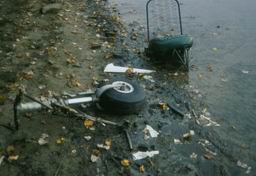
in the forest behind Sand Pond. When, at dusk, Brian Gleason came upon the
plane's front wheels and an oil slick that washed upon the shore of the
lake, it was then concluded that the plane went down into the water.
Divers were summoned the next day and eventually found the wreckage on the
lake's bottom;
"Officials of the Federal Aviation Administration were expected this week
to begin the task of raising and retrieving the wreckage of a twin-engine
plane that crashed into a lake on top of a mountain in western Sullivan
County Wednesday, killing the pilot.
"State Police, local fire and rescue personnel and divers found the plane
and its pilot in 40 feet of water near the northwest shore of Sand Pond
atop Shandelee Mountain at around noon Thursday.
"The body of the pilot, 44 year-old Mark Pressburger of Englewood, N.J.,
was removed from the scene. Pressburger was on his way from Teterboro
Airport in New Jersey to Sullivan County International Airport in Bethel
late Wednesday afternoon when he ran into dense fog. He crashed at about
5:45 p.m. on his second try landing at the fog shrouded airport 12.5 miles
away.
"No one else was believed to have been on board when the plane went down,
breaking open against tall trees and scattering luggage, papers and seats
on the shore before it hit the water. The spot where the plane and its
pilot were found was about 200 feet from shore. It is now marked with
small buoys."
September 25, 1990
Sullivan County Democrat
The plane laid at the bottom of the lake for over a week, until divers
were able to attach floatation devices that lifted the wreck to the
surface, and with a tow truck located on the lake's northern shore, slowly
winched the wreckage to land. One of the engines, separated from the main
chassis and deeply mired in the bottom muck, still remains in the lake.
fred
And would you believe that that plane went to a junk
yard in Liberty. It sat there a long time until a few years ago the son of
a friend of mine, the son's a pilot in Alaska, came down, bought the
remains of the wreck and took it back to Alaska to use for parts. And he
considered it a good deal cost wise!
evelyn
**********
More Shandelee Stories
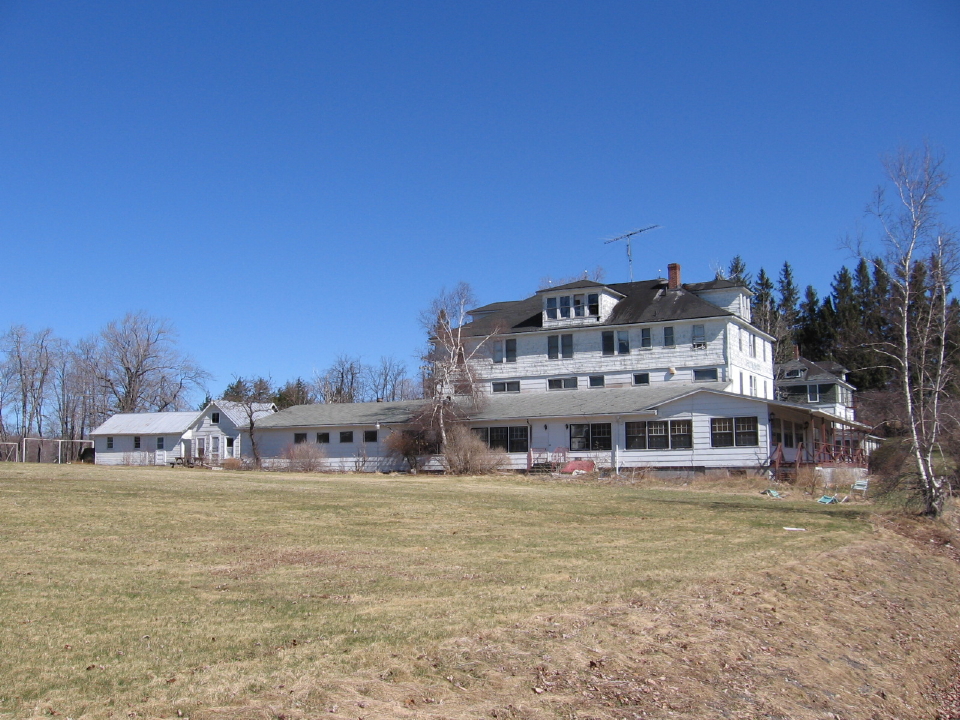
What was once very much a part of the history
of Shandelee will soon become only a memory as the hotel known as Menges'
Lakeside, along with most of the other buildings on the property, will
be demolished in the near future to make room for a new residence.
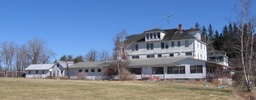
Though the premises had been used in recent years by a Korean concern,
little had been done on the upkeep of the buildings and one-by-one they
fell into disrepair. The main building, the original hotel, was
condemned by the board of health and sat vacant now for almost ten
years. The roof, which is always the first to go on a building, was not
maintained and eventually caused problems throughout the structure, in
some cases weakening the floor all the way done to the first story.
During an era of the numerous summer hotels and
boarding houses, summer employment for the local youth was easy to find.
The Menges family provided jobs for many of us, which for those of us
who worked there, would lead to many summer memories on Shandelee.
Fred - June 2008
The information concerning the fate of the Menges
Lakeside was written on June 25th, 2008. As of the moment the main
building is still standing but plans are in the wind of its soon demise.
Lake Rest is also gone. A winter's night fire, presumably unplanned, lit
up the Shandelee sky as the old hotel quickly burned to the ground before
firemen could get to the scene to save the structure. I believe the year
was in 1991, but I could be corrected on that if that is not so.
The real tragedy of the fire occurred the next morning. By dawn's light,
all that was left of Lake Rest was the brick chimney, rising tall above
the still smoldering ashes of what was once the three-plus story hotel.
One of the neighbor's boys, along with a friend, were being inquisitive
and were probing within the ruins, doing what inquisitive boys do. Just as
they were near the base of the tottering chimney, the whole chimney
collapsed, the bricks landing on one of the boys, trapping him underneath
the debris within the burning ashes.
No blame was placed on this deadly accident, but now the local firemen are
instructed not to leave chimneys standing above ruins by plying a stream
of water to knock it down to prevent a similar story in the future.
fred
*******************
My partner and I now own the property where the Lake
Rest used to be. Currently, there is nothing on that site except the
buildings that used to be referred to as b-cottage and c-cottage. There is
still a little cottage in the middle of the property and a small out
building near the lake which I heard someone refer to as the 'ice-house'.
The barn is also still standing.
The Lake Rest Hotel burnt to the ground on Sunday February 17, 1991 at
around 4am. The cause of the fire is still undetermined. As Fred
mentioned, sadly a local boy was killed when he ventured into the still
smoldering ruins and was crushed by a falling chimney. The boy, John
Hundley from Lower Willowemoc was only 14 years old.
We've been watching the progress of the Menges demolition. Sad to see the
old buildings go. But there really wasn't much left to save.
Paul
Thanks, Paul (bondi212), I appreciate the information.
Sorry to hear about the boy being killed, also ... I worked there in 1957
(I think) .. Will always remember it. It is always sad to see the old
buildings disappear... but life moves forward, with or without us. LOL.
Thanks, again.
MaryAnn
Thanks, Fred Fries! I almost missed this one from you!
It is good that this tragedy has taught the fire company something! Some
lives can and will be saved.
Someday I hope to get back up Shandelee and see what is there now. It is
still a beautiful place to visit, I am sure. I have mountains around me in
NC and just love going up and seeing the view. One we call Flat Top, and
it is quite a ride, but beautiful in the summer months to get out of the
heat. Thanks, Again.
MaryAnn
I have many photos and 8mm films of many summer vacations at Lake Rest,
Menges, Huber farm, etc. I never thought I'd be so sentimental about the
past, but I do know I was privileged to have so many happy times there. I
hope the new owners respect the land and bring something wonderful to this
beautiful area.
Susan Falk
******************
Menges Hotel
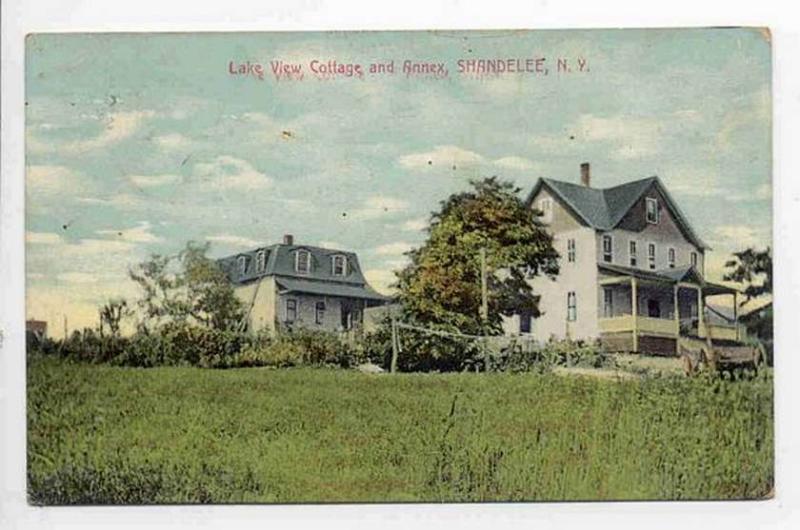
Before there was a Menges' Lakeside, there was the
Chestnut Grove House. Shandelee, like the rest of the region, began as a
farming community. With the penetration of railroad lines into the area,
first the Erie along the Delaware River and later, locally more
important, the O&W, visitors, escaping the summer heat and foul air
of New York City, became more numerous to the Catskill region, providing
an opportunity for farm families to supplement their income by taking on
these city guests as summer boarders.
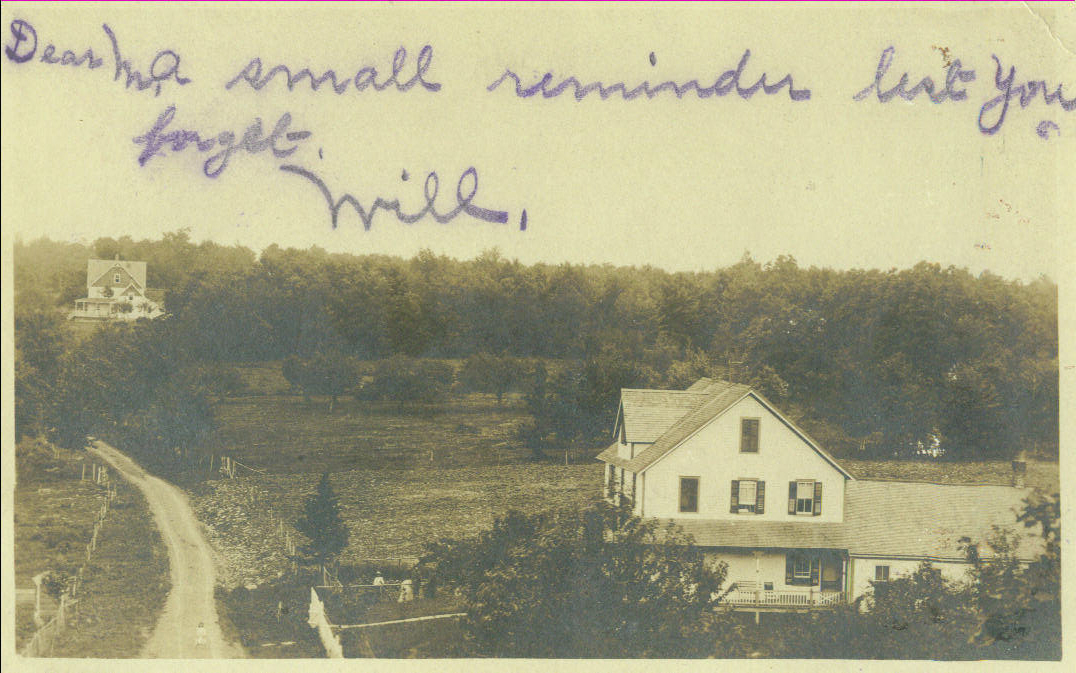
<click for big pix>
John Fries was the grandson of the earliest settler
on Shandelee Lake, Henry Fries, who also was the first documented
Shandelee farm family that welcomed city guests. John and his wife,
Elizabeth, purchased a large lot on the shores of Sand Pond, the twin
body of water to Shandelee Lake, and erected a large farmhouse, with the
original intention of providing space for summer boarders.
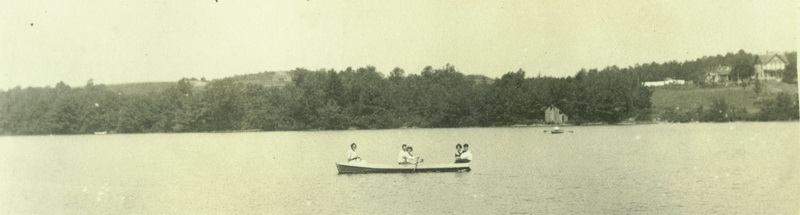
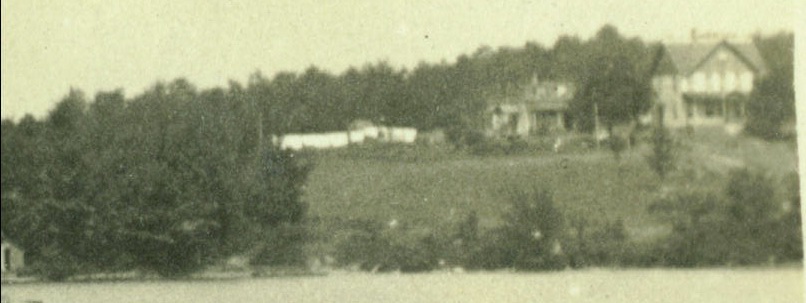
Sand Pond, still somewhat a wilderness, was noted for the groves
of chestnut trees along its shores, thus John and Elizabeth named their
boarding house the Chestnut Grove House. The Chestnut Grove House was
originally 32 feet wide and 28 feet deep. With the immediate success in
the boarding business, an addition was soon added to the main house
that consisted of the summer kitchen and included a
spacious dining
room.
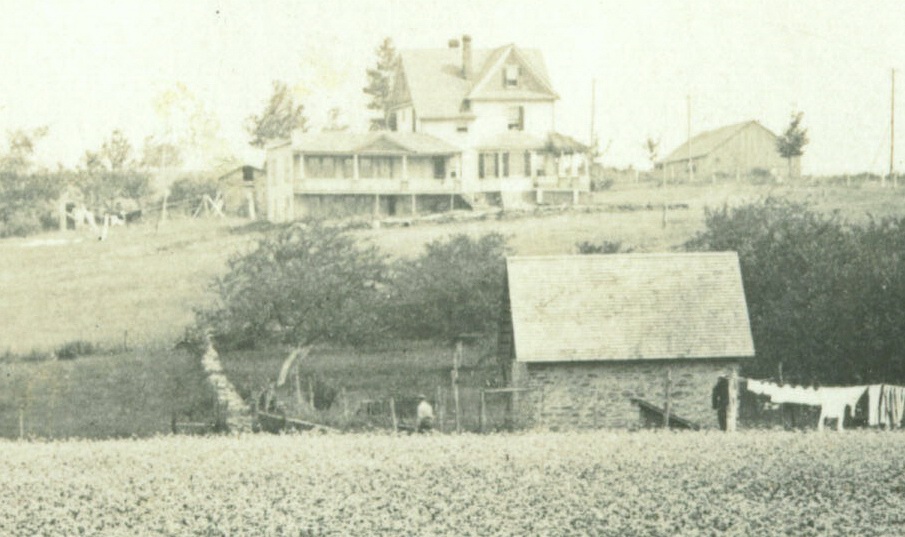
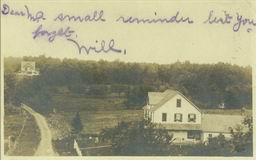
The image included is from a postcard, postmarked
1906, showing the Chestnut Grove House along with the proprietors'
family. Elizabeth, in the white dress, can be seen working in the garden
with her husband standing nearby. Two of their children, Fred and Anne,
are also in the photograph. Judging by the height of vegetation in the
garden, the photograph was probably taken in mid-summer, and noting the
wisp of smoke coming from the chimney over the summer kitchen, Elizabeth
must have been preparing for her guests, momentarily going out to the
garden to pick some fresh vegetables.
Fred
*****************
Shandelee Stories
Elizabeth Fries' daughter, Anne,
married a young man from Youngsville, Albert Menges, and in 1921 the
young couple took over the operation of the Chestnut Grove House. Al,
always chomping on a cigar, had a head for business; making dollars made
sense to him. He quickly renovated the old boarding house and turned it
into a hotel, adding a 38 foot addition onto the building and adding two
stories upon the whole structure
.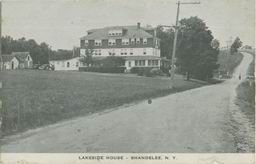
Along with the other buildings that were
added, his occupancy capacity increased and the establishment became a
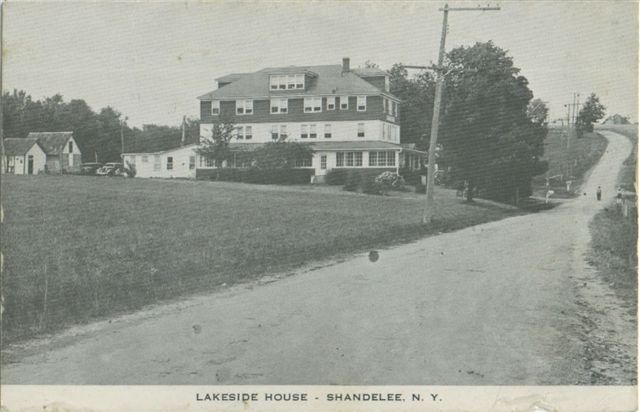
very profitable business. The hotel was now renamed the Lakeside House.
Fred
********************
The last chapter of the Menges Hotel / Lakeside
Rest story will be written this Saturday, July 12 at about 6:30am when,
according to members of the Livingston Manor Volunteer Fire Corp. the
old hotel will be burnt to the ground (weather permitting). Should be
quite a sight. pgbernasconi
******************
Shandelee Stories - The Waverly
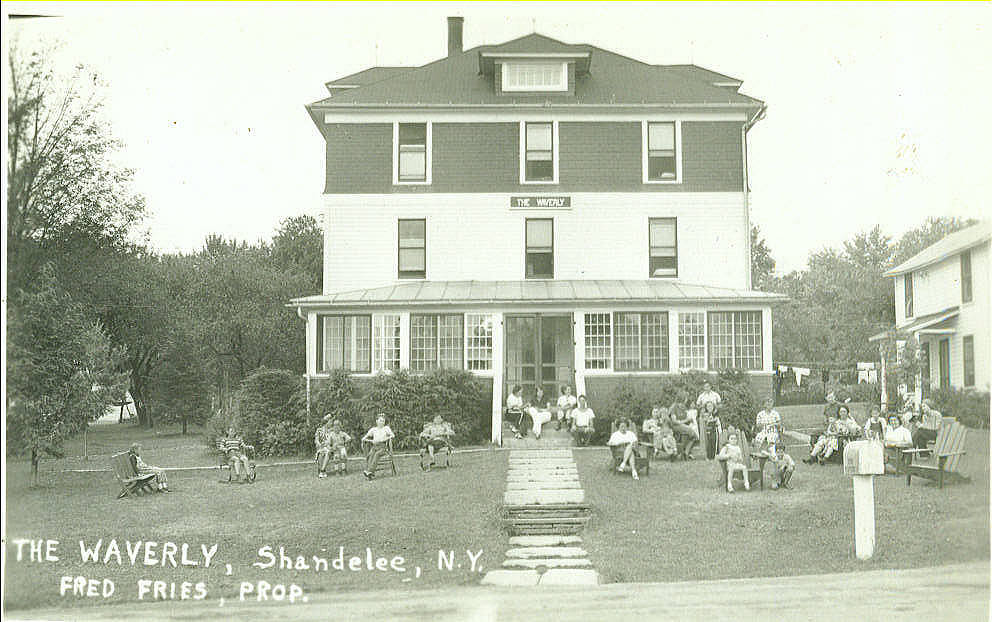
When his sister and her husband took over the Lakeside House,
Fred Fries separated from the family owned business and went into the
boarding business himself. His home was remodeled, adding a third floor,
and by the addition of cottages on his premises, was able to increase
the capacity of his small summer hotel. After the death of his first
wife, he married Wavie Edwards, a girl from Youngsville, and named the
new hotel after her, The Waverly. Though not as large as his sister's
Lakeside House or the recently renovated Lake Rest Hotel on the hill
next door, he still would attract over 100 guests on a busy weekend
during the heart of the season. On Shandelee during this era, the
"season" was considered to be from July 15th to August 15th.

<click for full-size>
His hotel continued to operate, though in a more
limited capacity, during Fred and Wavie's advanced years and in the end,
took in the overflow crowd from Menges' Lakeside. - Fred
*********************
Shandelee Stories - Waverly
"Pop" Fries' pride were the gardens and orchards that surrounded
his Waverly Hotel. The gardens were large, taking up most of the grounds,
well manicured, not a weed to be found, and productive. So much so that
the gardens supplied much of the vegetables used in the hotel's dining
room. Fresh corn, just picked and husked that afternoon, filled the family
style bowls set our for the guest's evening meal. And what was not used
for food was to be admired. Guests, walking the trail to the lake, passed
flowering plants and shrubs of every type and fragrance along the route.
So many apple trees were on the premises that it appeared that the hotel
was really just an apple orchard. Each tree, grafted, sprayed and
well-tended, produced apples for all occasions; pie apples, baking apples,
apple-sauce apples and just plain eating apples. And also, apples for
apple cider. During the prohibition, Shandelee farmers resorted to their
own brand of beverages, home-made wines, liquors, beer and apple-jack were
made and stored for private consumption or for use on special occasions.
Fred Fries' cider was particularly noteworthy, for he had procured a
number of whiskey barrels to store his apple juice during the fermenting
stage. The finished product was favored amongst Shandelee residents for
not only did the imbiber enjoy the effects of the hard cider, but the
drink gave a special "kick", the effects of the whiskey residue left from
old wooden barrels. - Fred
***************
Shandelee Stories
The relationship between Menges' Lakeside House and the Waverly
was somewhat unique owing to their close proximity and family ties,
brother and sister operating each hotel respectively. Because of this,
both hotels often shared services; over-flow guests, dining room
facilities, food deliveries, entertainment and a common driveway.
Wednesday nights, Menges' would hire a projectionist to run a current,
full length feature movie at the hotel, and since there was a lack of
space within the hotel, it was shown outdoors. Along the common driveway
between Menges' and the Waverly, a screen, or rather a very large sheet,
was strung-up between two maple trees and the Menges guests had ample
seating to view the movie. Likewise for the guests across the driveway at
the Waverly, for the image would show through the screen, allowing them to
view the feature from the backside. The only problem for the Waverly
guests was when the movie showed the credits, for what was a John Wayne
movie for the Menges side, was a eivom enyaW nhoJ on the Waverly
side.

- Fred
************************
Shandelee Stories - Pop Fries
Fred "Pop" Fries just had to see it
before he would believe it. Set in his ways, sometimes he was stubborn,
usually miserly, and occasionally grumpy, but still received true
affection from his summer boarders, most of whom kept in touch with him
and his family throughout the winter.
His son, Buster, was the starting pitcher for Livingston Manor Central
School baseball team, and a good one. A strong, scrappy lad, Buster
learned to pitch a curve ball, which with its sweeping downward curve, led
to his high school success. His father wasn't able to attend many games so
when he was told of his son's pitching success and that he had a real good
curve ball, he didn't believe it. Badgering his son, Buster offered to
throw his father the pitch to show him. Going out behind the house, Pop
set up over a home-made home plate with a baseball bat in hand and Buster
paced off 60 feet, and set to deliver the pitch.
The ball left Buster's hand and made a bee-line towards Pop's head. Seeing
the ball coming straight at his noggin, Pop leaned forward, but as he did,
the ball seemed to follow his motion. He then bent down, low over the
plate, to duck from the pitch, but the ball again followed his movement
and just as the ball came to the plate, Pop's head was already there. The
plate area wasn't large enough for both head and ball at the same time and
the resulting collision of cowhide and skull crumpled the father to the
ground. The pitch was a perfect strike, but Pop was too stunned to know
it. After recovering from the blow, he never questioned his son's
curve-ball pitch again; he saw it, he believed it and he felt it! - Fred
************************
Shandelee Stories - The
Waverly
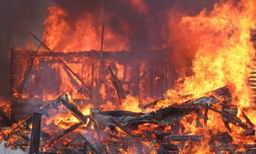
Engulfed in a wall of flames, a firestorm swept over
the buildings of the Waverly Hotel sending heavy, black smoke billowing
up into the early morning winter sky and reducing to ashes the last
remembrances of a Shandelee story. On the morning of December 22, 2007,
volunteer firefighters from the fire companies of Livingston Manor and
Youngsville set ablaze the Waverly compound during a controlled burn,
standing by with their equipment as the buildings burnt to the ground,
protecting the nearby neighboring buildings from the intense heat and
flames generated by the doomed structures. The fire made quick work on
the ninety-eight-year-old main house and accompanying buildings,
its deed finished mostly within an hour.
<click for full size>
But history can be stubborn in giving up its hold on
a place as wisps of smoke continued to rise from the smoldering embers
for many days after. On Christmas eve, as artificial Christmas
decorations adorned the neighboring residences, the glow of numerous
embers within the Waverly's rubble flickered throughout the evening's
darkness, casting a more earthly luminescence for a final season's
greetings, and its final Shandelee story. - Fred
**********************
Shandelee Stories - The
Waverly End
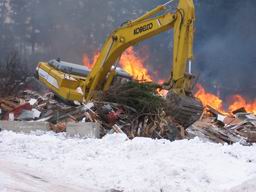
The main building of the Waverly Hotel was no match for modern
equipment, designed for demolition. Due to the proximity of the house to
electric lines passing overhead, the main house was demolished first and
then fed onto the fires that consumed the other buildings. Fred
<click for full size>
************************
Shandelee Stories - Menges
For Harold Menges, the bombing of Japan during the summer of 1945
and that country's ultimate surrender was cause for celebration; the war
was over and he would now be coming home. Harold A. Menges, the son of
Anne and Albert Menges, the proprietors of the Lakeside House, served in
the US Navy, a cook aboard a ship which was part of the Pacific fleet.
When he returned, Harold, who was better known by his nickname, "Ham",
became a partner with his parents in the family hotel. He married Della
Judson in 1950 and soon after, the young couple took over the
proprietorship of the Lakeside House.
Della had a head for business. With Ham in charge of the kitchen, she ran
the business office. During the era when summer hotels in the Catskills
were now beginning to experience difficult financial times, the Lakeside
House, now renamed Menges' Lakeside, proved to be the exception. Della and
Ham continually invested money back into their hotel, adding
accommodations and constantly renovating and improving the premises to
meet the ever-changing wants of their guests. The food was always superb
and, thanks to Della, the place immaculate. The kitchen, after the
preparation of each meal, was cleaned to a sparkling condition. If ever a
place could be described as being clean enough to be able to "eat off of
the floor", Della's kitchen
would be the place. In her passion for cleanliness, she would train
her staff on her methods of cleaning. She was not afraid to roll her up
her sleeves, during her training sessions, and show how to clean a toilet.
She was a strong, demanding lady who also was loyal to those who worked
for her. With the common petty complaints often generated by her more
ornery guests, Della always supported her staff.
Ham was of a more gentle nature, but a whirlwind in the kitchen when
preparing the meals; trays of food being prepared shifted here to there,
from recipe to ingredients, pots filling the stoves and ovens, all during
the frenzied hours before serving the guests. Ham was also a stickler for
detail. Proud of his duty in the service, each morning the
stars-and-stripes were raised up the flagpole on the hotel's lawn by the
staff. At the end of the day, two boys brought the flag down, standing at
attention, as instructed by Ham, and always properly folding the flag. Ham
was always of a happy disposition, with always a whistle while he worked,
and often with a twinkle in his eye.
Of all the traditional holidays celebrated at the hotel, none was more
important than V-J Day, the anniversary of the signing of the peace accord
with Japan, signifying the end of the Second World War. Ham went all-out
with that evening's meal, capped off with the serving of wine to the
guests. The meal would begin when Ham entered the dining room, which he
rarely did during the summer season, and proposed a toast to signify the
importance of the day. The celebration did not end when the guests left
the dining room, for the bus-boys, while cleaning off the tables, would
collect the wine bottles that were left on the table and bring them back
to the dish-washing area where they, along with waitresses who could sneak
back to that isolated corner of the kitchen, would continue their underage
celebration. Though seemingly unaware of such tom-foolery, Della and ham
always kept a watchful eye on the young charges under their employment and
though taking that responsibility seriously, seldom was there the need for
discipline. For that reason, members of the staff returned
year-after-year. - Fred
***********************
Shandelee Stories - Menges
As the summer months during the boarding season dragged on,
relief from the tedious work of waiting on the hotel's guests during the
long, hot summer days often was in the form of pranks played on each other
by the youthful staff at Menges'. These mischievous episodes, more than
just short-sheeting the beds, created a friendly rivalry between the boys
and girls as each group tried to outdo each other. A bathroom completely
filled with crumpled newspapers would be eventually answered when boxes of
Jell-O were administered to the bowl of a toilet, each feat escalated from
the previous escapade.
Work for the serving of the evening's meal began at five o'clock as the
staff readied the dining room and kitchen for the coming onslaught of
hungry guests. The boys cleaned up from Ham's afternoon of food
preparation along with other general duties in and out of the kitchen
while the waitresses, dressed in their civilian clothes, would be
responsible for setting-up the tables and their stations in the
dining-room. When the girls were done, they would escape to their summer
living quarters, the "girls shack", located just behind the kitchen, and
change into their waitress uniforms.
Labor Day weekend, being at the end of the season, often was one of the
busier weekends of the season, the hotel usually filled to capacity,
while the aded work in the dining-room cut short the time needed to meet
the six o'clock dinner chimes. The girls, already short on time for their
change-over, finished their dining-room duties and went back to the girls'
shack to change their attire only to find the front door of the building
missing. Further investigation revealed this was not all that was missing,
for all the doors inside, as well as all the window shades were gone. They
immediately went to Della with their complaint who in turn went to Ham,
who was generally in charge of the boys' crew, the most likely culprits.
As Della told Ham the plight the girls were in, Ham responded in his usual
calm, non-committal manner, answering her that he hadn't noticed them
missing when he came to the kitchen earlier in the afternoon. Della walked
away in frustration while the girls, pressed for time, were forced to make
do with the door less situation. The snickering heard coming from back by
the dishwashing machine in the far corner of the kitchen were the boys
enjoying the success of their handiwork.
Ham, of course, had no doubt of what had happened and soon came back to
the boy's work station, and with a slight smile on his face, told the boys
that he didn't know what happened to those doors, and didn't want to know
either, but perhaps the boys could set out and look for them. The last
laugh for the season had been had, and soon, as the evening's meal
proceeded, all the gaping holes in the girls' shack were again filled with
the proper door, every hinge back in place. The girls would need to wait a
year for their revenge. - Fred
***********************
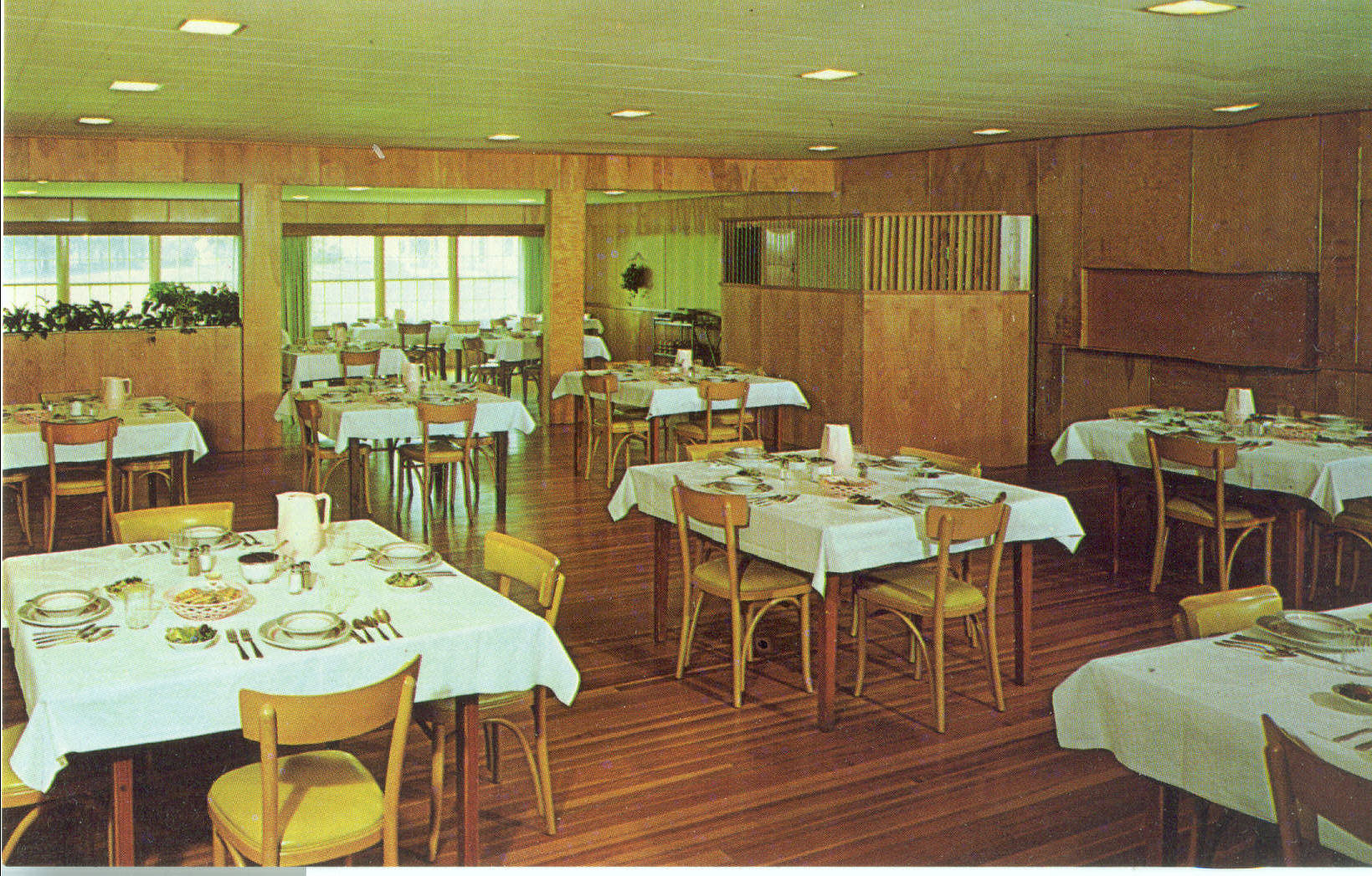
Shandelee Stories - Menges burning
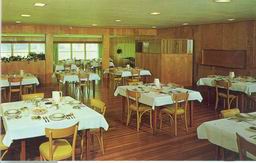
The dining-room of Menges' Lakeside.
Shandelee Stories - Menges burning
<click pictures for full-size>
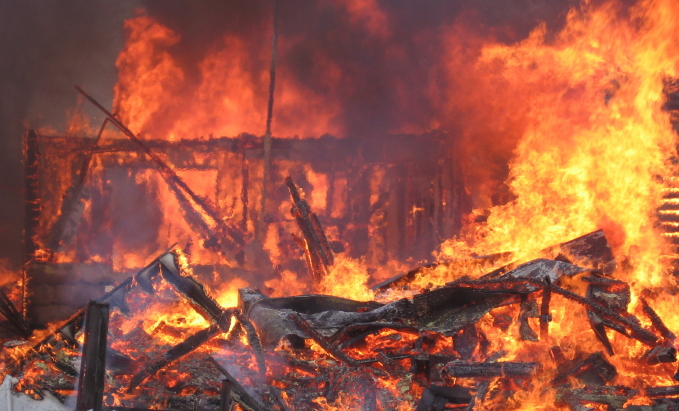
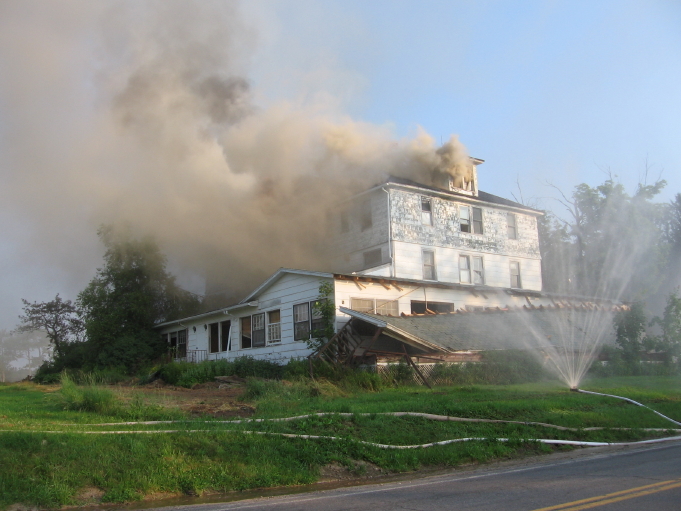
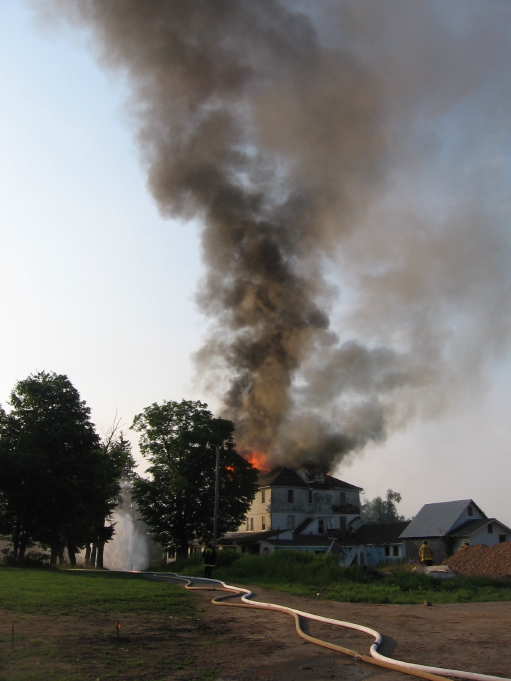
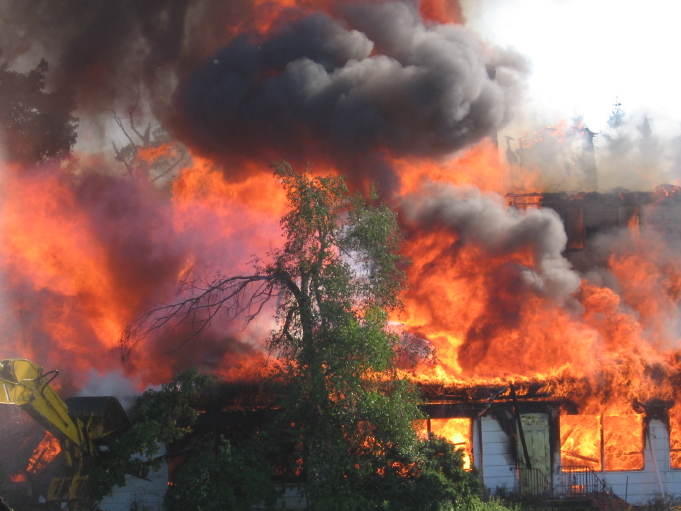
It was to be a controlled burn. Experience
is perhaps the most important weapon for volunteer firemen when fighting
fires, and control-burn fires allowed for this training, testing their
fire-fighting skills and the use on their equipment. Besides the
training, the danger of a building fire, especially that of the size of
the old Menges hotel was real, therefore a plan was needed to minimize
the dangers. A blaze started haphazardly would soon become a raging
inferno, the flames uncontrollable, and with the potential searing heat,
there would be the possibility of damage to the overhead utility lines
and the residence just across the street.
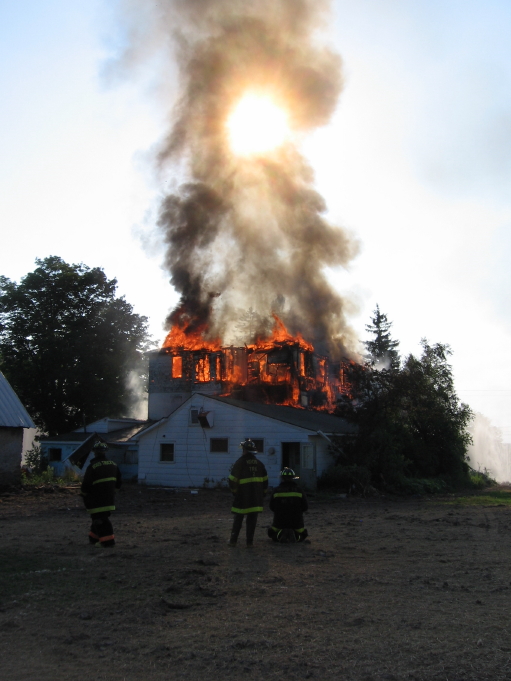
Firemen began assembling on the site early
in the morning of July 12th, just as the sun was rising, its rays
illuminating the old hotel for the very last time. Though the purpose
was to bring the building to the ground by the blaze, water, and a lot
of it, was needed to help direct the planned course of the fire. For
this, two fire-trucks used fo pump water were sent to the lake's shore,
over one hundred yards distant, with large hoses sent up to two
locations near the building. The Youngsville fire company set up
operations on the neighboring Waverly property while the Callicoon
Center fire company truck sat on the other side of the building, upon
the Menges lawn, both being less than fifty yards away from the doomed
structure and both were attached, either directly or indirectly by use
of a large inflatable vat, to the end of the pumper-trucks' hoses. These
two fire companies' purpose was to keep the front exterior wall intact
as the rest of the structure was consumed by the fire by applying
streams of water onto that side of the building as well as laying out a
heavy mist. This would serve two purposes; diminishing the heat on that
side of the building keeping that wall intact, and, as the fire
progressed in the center of the building, the weight of the exterior
front wall would hopefully collapse into the center of the fire, away
from the road and overhead wires - Fred
.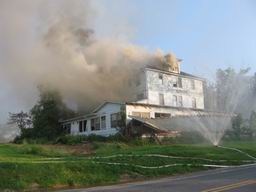
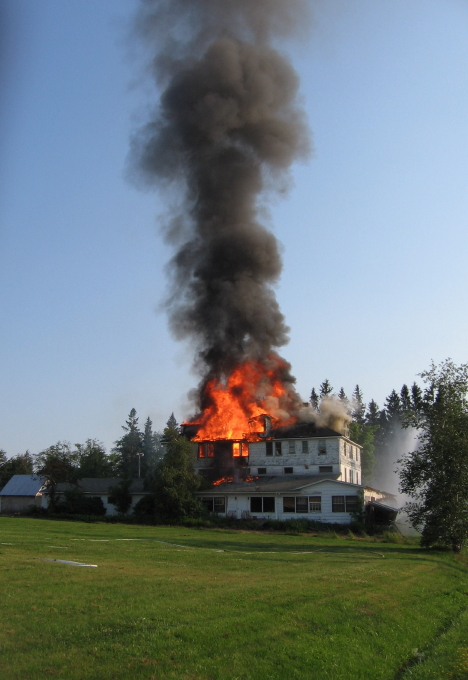
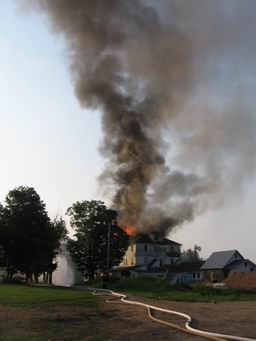
It began with the sound of busting glass,
as those in charge of igniting the fire broke the windows out of the
roof dormers and soon smoke was observed billowing out. Shortly, flames
replaced the smoke at the window holes as the dormers became engulfed in
flames, the fire slowly spreading along the roof. The resulting smoke
was now the fire's dominate feature as it rose from the full width of
the seventy-foot long structure, converging above to form a plume that,
this day being a day with little breezes, arose hundreds of feet
straight into the cloudless sky. - Fred
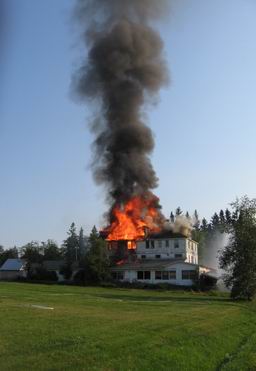
Slowly, the fire worked its way down the
center portion of the building, floor by floor, consuming all of the
outside walls except the one in the front, as planned, which still was
protected by the firemen's efforts. A strange mixture of fire, smoke and
rainbows formed along the front of the building as water, reflecting the
morning sun's rays, was continually sprayed onto the exterior front
wall, forming a river of runoff that drained down the highway's sluice,
inundating the neighboring lawn across the road. Finally, as the fire
was now working down onto the second floor of the structure, a loud
cracking noise signaled movement of the front wall, which, seemingly in
slow motion, laid itself gently back into the inferno behind it, now to
become added fuel for the fire.
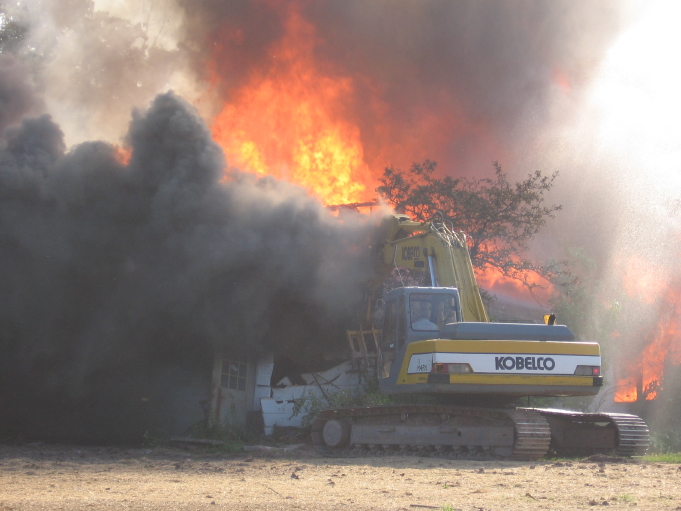
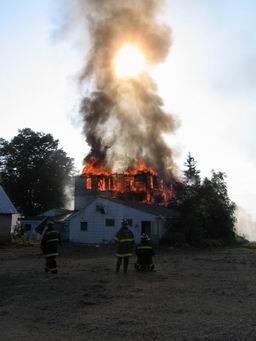
As the fire progressed downward, the
remains of each floor dropped onto the floor below adding to the
conflagration, until when down onto the first floor, the fire was at its
most intense as the flames spread throughout the whole area of the
building. Out the back, where the addition that housed the kitchen was
located, heavy, black clouds of smoke shot out the back door. The
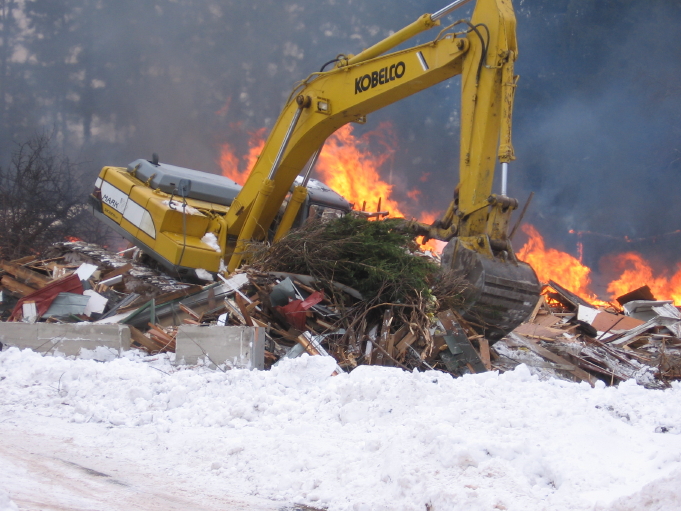
excavator on the site, which was to be used to assist the fire to
consume as much of the building as possible, now was put to use, its
bucket at the end of the long, hydraulically operated arm, punching at
the kitchen's roof to get oxygen into the fire now burning in the
kitchen. The area that was used to feeding so many guests over the years
of the life of the old hotel, was now in its final act of feeding the
fire that was soon to destroy it.
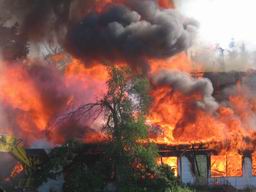
The large machine worked alongside the
ongoing fire and the intense heat that was generated, pulling the
non-burnable items, such as the iron beams from past renovations and
basement water tanks, from the flames. To combat the intense heat,
firemen now directed their hoses onto the machine, spraying the cooling
water onto the bucket and arm as it worked within the fire in an effort
to prevent damage to the operating equipment of the machine. As the
driver manipulated the fire within the building's foundation with the
long arm of the excavator, he needed to run the machine's windshield
wiper to get a clear view of his work, now being in the midst of both
fire and rain.

What can be a catastrophe for some folks,
is merely a spectator sport for others. The planning of the controlled
burn was planned for over a month in advance, and since it was not meant
to be kept a secret, word spread quickly throughout the community, and
well beyond, of the proposed date. When the fire was started, traffic
was held up by the fire-police from all the participating fire companies
at distant locations along the Shandelee Road and forced to detour
around the site, with the usual grousing from those drivers in a hurry
and not wishing to be inconvenienced. When the threat of the collapsing
front wall was over and the firemen no longer needed to use the road as
a staging area for their water-fighting equipment, traffic was again
allowed to pass, though only one lane was used. Being in the midst of
the summer season, nearby summer residents began to congregate as the
smoke began to rise from the building. As the size of the crowd
increased, they were held a distance back from the site, both for their
own safety against the unexpected, as well as keeping them from being
underfoot of the firefighters. Within two hours, the "entertainment"
portion of the fire was over, and the crowd dissipated, the road now
fully restored to traffic, allowing the drive-by gawkers from both
directions.
It was a controlled burn; the building was
brought down safely to the ground. For days afterward smoke arose from the
smoldering ashes of the hotel, now lying as debris within the
very foundation on which it stood on for over 120 years. It will soon to
be excavated and filled in, leaving little evidence of the previous
existence of such a place, now only a memory, a relic from a different
era. Those who may have lived on Shandelee during those years, the many
guests and their families who frequented these houses, and the many young
people who spent their youthful summers working for the proprietors, will
always describe their own Shandelee stories when remembering those days.
But for now it is the scene for a new set of Shandlee stories, those to be
generated from a new family, in a new era. Hopefully, their stories will
be remembered as fondly by them in the future as those that are now
being remembered from times now gone by.
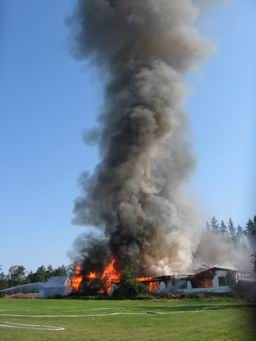
As the excavator worked along the perimeter
of the foundation, there was one cause for alarm, at least for those of us
who observed from a distance. As the machine's long arm was "playing" in
the fire, a large explosion occurred, seeming to come from under the
ground beneath where the excavator was working. Perhaps an underground
fuel tank was located there, and since the fire was now in the basement
section, flames may have followed the oil line into the tank, exploding,
or since there was no noticeable plume of smoke or acceleration of the
fire, imploding the tank underneath the surface. Whatever the case, no
harm was done.

Story and Pictures by Fred
*******************************
|
Trophy Year
The culmination of the 1959-60 basketball season for the
high-school boys from Livingston Manor was the winning of the Class C
Section Nine State Title. This feat, accomplished by winning all of their
games that season, was celebrated throughout the community, until this
feeling of joy was quickly tempered by the shocking news of one of our
residents. Arthur Gebhard was a member of the loyal following who
religiously attended the local school's events. In fact, Gebhard devoted
much of his time serving the area's youth. A leader in the local scouting
movement, Gebhard organized the Weblos pack for the Cub Scouts of
Livingston Manor. His leadership skills working with these young scouts,
along with the children within his chosen profession, reinforced his faith
for the future and was praised by all within the town. We were all stunned
with disbelief when the saddened community learned of the tragic event
that unfolded on the evening of April 7th, 1960.
**************
Arthur L. Gebhard Jr.
was born on January 5th, 1925, at Mount Vernon, New
York. As with so many boys growing up in this era, his youth culminated
with the enlistment, while still a teenager, into the armed forces during
World War II. He joined the Army Air Force where he became a radio
operator on a bomber and flew thirty missions. After the war, Gebhard
answered the call for a different mission; becoming a student at Princeton
Theological Seminary. In 1953, both the Livingston Manor and Roscoe
Presbyterian churches were without full-time ministers, using substitutes
ministers to serve their needs. A senior at the seminary, Gebhard was
often used to deliver the Sunday sermons for these churches and as his
graduation approached, he expressed his desire to serve these two
communities. He was installed as the minister for both churches in April of
1953.
"Sunday, April 26th, forty members of Roscoe and Livingston Manor
Presbyterian Churches traveled to Yonkers, New York, by a chartered
Short-Line bus to attend the ordination by the Presbytery of New York of
Mr. Arthur Louis Gebhard.
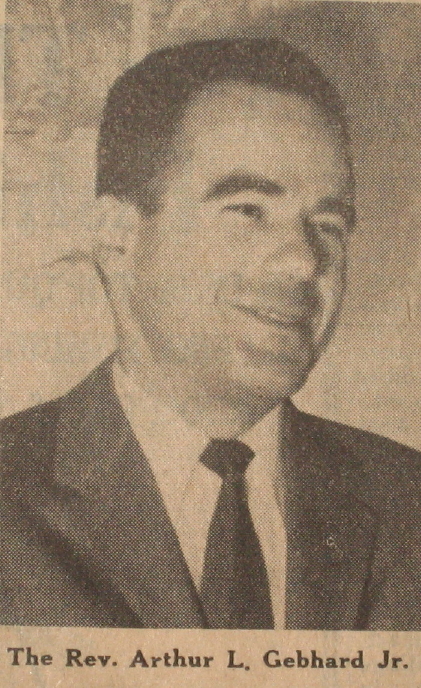 "Mr. Gebhard was ordained in his home church, the Woodlawn Presbyterian
Church of Yonkers. The sermon was given by one of his professors at
Princeton Theological Seminary, the Rev. Harmon V. Hope, D.D. and the
charge was given by his old friend and pastor, the Rev. Neumann H. Hess of
Woodlawn Presbyterian Church. "Mr. Gebhard was ordained in his home church, the Woodlawn Presbyterian
Church of Yonkers. The sermon was given by one of his professors at
Princeton Theological Seminary, the Rev. Harmon V. Hope, D.D. and the
charge was given by his old friend and pastor, the Rev. Neumann H. Hess of
Woodlawn Presbyterian Church.
"The Rev. Mr. Gebhard will be installed as pastor of Roscoe and Livingston
Manor churches Sunday evening, May 17th. He will come to reside with us
this week and will begin his work with the two congregations immediately."
April 30, 1953
Livingston Manor Times
**********
Reverend Gebhard
The Rev. Mr. Gebhard was a personable, mild-mannered fellow,
though somewhat withdrawn, and upon his arrival to the Manor was
immediately attracted to a girl somewhat opposite his disposition. Gloria
Runge was the instrumental teacher at Livingston Manor Central School, a
talented girl who hailed from the upper Midwest, popular and more outgoing
than the Reverend. Both, though, had a common interest; working with the
youth of the community. She shared her musical talent with the children at
school, developing a strong instrumental program while he immersed himself
into the Boy Scout movement. Together, they strengthened, and added to,
the existing youth programs of the church.
In July of 1954, the congregations of both the Manor and Roscoe churches
were informed that their church would be closed during the month of
August, and for that period it was advertised that they should attend the
services of other churches within the community. The minister would be
available for counseling services only up until July 31st;
"The Rev. Arthur Gebhard and his bride, the former Miss Gloria Runge, are
at home now in an apartment over the Rose Hardware Store. They were
married August 14th, at Roosevelt Drive Presbyterian Church in Milwaukee,
Wisconsin, spent their honeymoon at Chatauque, New York, and returned to
Livingston Manor last Friday. Mrs. Gebhard will resume her position of
instructional music in the central school. Mr. Gebhard will again occupy
his pulpit in the Presbyterian Church which was closed during his
vacation."
September 2, 1954
Livingston Manor Times
**********
Trophy Year....The Rev. Mr. Gebhard
The unassuming, reserved Arthur Gebhard won friends throughout the
community, though many thought of the quiet man as being somewhat distant.
The newly married coupled continued to devote their professional lives to
the community's youth, Gloria with the school's music program and the
Reverend through community and church youth programs. The marriage seemed
to inspire the Reverend, relishing the thought of the couple spending
their lives together. A letter sent to his congregation during the 1954
Christmas holidays seemed to reflect his upbeat mood as he wrote; "We look
to the future with enthusiasm and hope." The Sunday sermons were
optimistic, church attendance was up and the church school was thriving.
As members of the Livingston Manor Presbyterian Church began planning for
the upcoming 75th anniversary of the church's existence, during 1955, The
Reverend wrote, regarding the future of the church; "...there is no
question that problems will be faced and surmounted." Personal problems
for him, however, would prove more difficult to conquer.
Sadly, the relationship between Gloria and the Reverend did not work and
they separated, the marriage eventually dissolving into divorce. She left
the community and became the music instructor at the Monticello school
while Gebhard remained at his pulpit, withdrawing deeper into his faith
and immersing himself into his work within the church. He became moderator
of the Hudson Presbytery, promoted the local church with Sunday services
broadcast over the local radio station and during the winter of 1960,
joined other ministers from the Presbytery on a preaching mission to
Puerto Rico. But with the Easter holidays approaching, and the demands
that the season normally requires from the church leader, people noticed
that Gebhard became more sullen; some thought him to be in a depression.
Besides the normal Sunday services and the regular weekly church groups
meetings, he scheduled services on Wednesday evenings throughout the
Lenten season. This busy Easter schedule only masked his ever deepening
despair, though apparent to some who followed the text of his Sunday
sermons that spring. Two in particular, titled: "The Words of Compassion"
and "The Words of Human Needs" seemed to strike a more personal note.
Reverend Gebhard
With his Palm Sunday sermon completed, Reverend Gebhard planned to
attend the dinner meeting on Thursday evening, April 6th, of the Sullivan
Council of Churches at Liberty. His plans, however, were drastically
changed late that afternoon when he became overcome with his inner
feelings of hopelessness. His car being parked inside the garage behind
his apartment, Gebhard attached a vacuum hose to the end of the tailpipe,
ran the hose through the trunk and backseat into the car's interior. He
then started the car's engine and sat inside, waiting as the exhaust fumes
slowly seeped the vital oxygen supply from his blood, causing the spell of
a relieved unconsciousness that opened the gate to his eternal home.
The community responded to the news of the death of the Reverend Mr.
Gebhard with more than the usual fashion of shock and dismay. The tragedy
of this lone, lonely figure, was not just the act of his desperation, but
the slow accumulation of his self-perceived personal failings that went
unnoticed, or ignored. The man who preached words of compassion,
confidence and human needs, spoken to heal the soul and offer hope, was
unable to heal himself, falling into a sense of hopelessness that the
community failed to understand until the eulogy was written; "As the
cold words are put down describing a person's life and death, through your
mind pass the things you shared; one last conversation, an event you both
took part in, the sound of his voice, the way he dressed and talked, your
common interests. All these and many more are your remembrances.
"Qualities and characteristics that comprise a person's personality win
him friends or enemies and impress his memory on those whom he has contact
with in life. These can never be satisfactorily transferred into written
words but must live on in the memory of all of us as we remember him.
"Words are insufficient to describe our feelings for the loss of the
Reverend Arthur Gebhard. He has found a place in our hearts as he did with
many other friends he had in the community. A quiet man, he worked hard
for his flock and the church, and when his time permitted, he gave a hand
in community events. We only wish that there had been time to come to know
him better."
Editorial of Capron Battey
April 14, 1960
Livingston Manor Times
Time, compassion, and perhaps understanding, for Arthur Gebhard may have
altered his tragic course, but when finally realized it was too late.
Fred
******** Glory Days
The upcoming high school basketball season in the fall of 1960 was to
begin on a similar, sad note that ended the recent, highly successful
basketball season earlier that spring; the sadness of another tragedy.
This one, though, would strike closer to home within the school community.
For some of us, this was a time when the car we drove was our first love.
Polish and shine, tinker and tweak, redefining the original machine to
enhance its perfomance. Alfred Steele loved working on these road
machines. A classmate of the class of 1960, Alfred didn't participate in
after-school sport activities, but enjoyed tinkering with machines. During
school, he was a member of the projection club, keeping the projectors in
running order for the running of films in the classrooms. After school, he
worked as a mechanic over-town at the Owl Service Station.
On Friday night, the day after Thanksgiving of 1960, Alfred was travelling
with a posse of cars. Along Route 52, between Youngsville and
Jeffersonville, Steele's car slammed into a utility pole along the
highway. His friends, following close behind, immediately came upon the
wreck, but Alfred died before help could be summoned. The loss of one of
our boys always was, and still is, a shock to our community.
"The first basketball game, a non-league game with Roundout Valley, is
scheduled for December 2. this year's varsity consist of John DuMond, Don
Greenlee, richard Diescher, John Hoos, Richard Robinson, Charles Banks,
Richard Welch, dave Young, Carl Eugeni and Harold VanAken.
"The junior varsity lineup is; Richard Dolgas, Gary Rose, Walt Weigand,
Eugene Summerson, Joe Hauptfleisch, Tom Allen, Richard Fries, John
Schmidt, Dave Allen, Richard McKune, Tom Vick, Frank McGreevy, James
Denman, James Sherwood and Steve Baldwin."
Helen Steinman
November 17, 1960
Livingston Manor Times
********* More Glory Days
By the end of 1960, the tensions from the era known as "The Cold
War" were to a point of a national frenzy. Our vocabulary expanded with
phrases such as "Iron Curtain", "domino theory", "better dead than red",
"mushroom-shaped cloud" and "fall-out shelter". During the first week of
December, the PTA of the Livingston Manor Central School sponsored a
program on civil defense, including speakers advising us on how to survive
a nuclear attack and the assembling of a full-scale fall-out shelter. The
model shelter, made of simulated concrete blocks to the dimensions of nine
feet deep, seven feet high and eleven feet long was on display at the
school for a week with tours of the shelter given by the local civil
defense workers to the children as well as to the members of the
community. The concrete box became a popular attraction and after the
program, the children were drilled in the practice of hiding under our
desks when the "big one" hit.
"Friday night's game was a thriller-diller! Roundout Valley was ahead for
more than half the game but the Wildcats roared into the lead to end the
game. This first victory of the 1960-61 season numbers the 20th one for
the Manor Wildcats. Final score was Manor 55, Roudout Valley 51.
"Another non-league game with St. Joseph will be played Friday, December
9th.
"A dance sponsored by the cheerleaders will be held Saturday night. Pizza
will be served, so come - join the feast."
December 15, 1960
Livingston Manor Times
******** Glory Days
Mongaup Pond, situated amongst the wilderness tracts above DeBruce, is
said to be the largest natural body of water within the boundaries of
the Catskill Park, or as it is often said around here, within the "Blue
Line". The history of the large parcel of land which surrounds the
one-hundred acre pond, over thirteen-hundred acres of forests, was
limited to either the wood industry or recreation. Since the earliest
land owners, Judge Low and later Stoddard Hammond, to the more recent
lumber camps of the nineteen-thirties and forties, attempts have been
made to harvest the virgin timber but due to the tract's isolation, the
property was never fully exploited. As a result, the area around the
pond remained unsettled and undeveloped, a rarity in the Catskills.
In December of 1960, the Conservation Department of New York State
utilized a recently enacted law by State's legislature, Section 13 of
the Conservation laws, to take title on the property. The law gave the
Conservation Department right to appropriate land that was to be used
for recreational purposes. Communities within the area, including
Livingston Manor, were in favor of the State's takeover, increasing
recreational land in the area for both the local residents as well as
non-residents. There was, however, one problem. The owner of the Mongaup
Pond property had just sold the property; to the North Bergen County Boy
Scout Council.
As it did the year before, the editors of the Livingston Manor Times
failed to record the results of the early-December high-school
basketball games in its newspaper. Both were victories, against
non-league foe St. Joseph and the first Western Sullivan League game of
the season against rival Tri-Valley. Apparently the Batteys, the
publishers, failed to see history in the making;
"Last Friday night, the Wildcats of Livingston Manor Central School
broke loose for their highest total of points as they snowed Eldred
under a barrage of 76 points.
"The first quarter appeared to show signs of a close game as the Manor
led by a slim margin of 18-17. In the second period, the Wildcats broke
loose for a total of 31 points as they showed their superior skills in
moving the ball, with deadly shooting and showing excellent passing. It
was in this guarter that the Manor showed its finest team-work of the
year. The half ended with the home team leading 49-27.
"The reserves took over in the second half and continued to build up the
score to a final 76-45 total.
"The three veterans, Richard Robinson, Charles Banks and John DuMond led
the scoring with Robinson leading the way with 22 points.
"The Livingston Manor Junior Varsity continued their streak by taking
their fourth straight game, downing Eldred 59-27. Tom Vick was high
scorer with 21 points."
December 22, 1960
Livingston Manor Times
***************
Glory Days
For the third consecutive year, the members of the Livingston
Manor
Rotary Club, led by George Body, held their sponsored winter ice-carnival,
and again, the weather for that January 15th, 1961 afternoon was ideal for
the outdoor activities. It was estimated that over 1,500 people showed up
at Walt Seeley's ice-rink below the school. This year, the queen of the
event was junior class member Harriet Schleiermacher.
The beginning of that weekend saw the boys basketball team test their luck
against the ever-dangerous Paul Zintel coached team from Jeffersonville;
"Friday, January 13th, did not break the spell of the Livingston Manor
Wildcats as they defeated Jeffersonville 66-48. Playing before the largest
crowd in many years at the Jeffersonville court, the Western Sullivan
League champions claimed their way to their 26th straight win.
"Little John DuMond put on his greatest performance with some deadly
shooting from the outside, ripping the cords for 22 points. Rich Robinson
took care of the scoring from the inside with 21 and with the help of
Charles Banks, controlled both offense and defensive boards.
"The Manor spurted to a 15-10 first period lead, but Jeffersonville came
right back to close the gap by 31-28 at half time. The Manor had the
better of it in the third quarter and opened the lead to 45-38. The final
period was too much for Jeffersonville as the "Cats" exploded for 21
points to win going away.
"The Junior Varsity squad, led by Tom Vick's 23 points defeated
Jeffersonville 55-44. Walter Weigand added 11 and played an excellent
game. Walt was also the standout with his consistent rebounding."
January 19, 1961
Livingston Manor Times
*************
Glory Days
Ownership of the Mongaup Pond and the surrounding wilderness tract
was still very much in doubt by mid-January of 1961. One thing was certain
though; both the State Conservation Department and the Bergen County Boy
Scout Council filed papers certifying ownership with the county clerk at
Monticello. Though the scout organization allegedly purchased the property
from Silvan Kocher, the state took title by means of Section 13 of the
Conservation Law, allowing the state to take lands for recreational
purposes.
To combat the department's takeover, the Bergen County Council initiated a
letter-writing campaign, bombarding the governor's office with telegrams
and letters, requesting him to order the department to give up the land.
Meanwhile, the quest for the continuation of the winning streak for the
LMCS boys basketball team was also very much in doubt when a spirited
Roundout Valley team played the Wildcats on the 17th, the Ganders leading
throughout most of the game;
"John Hoos scored a layup almost at the final buzzer to haul Livingston
Manor from the brink of defeat and stretched the Wildcat's long sinning
streak to 27 games with a 56-55 victory over fired-up Roundout valley
Tuesday night.
"Hoos banked the clutch basket to climax a pulsating contest which saw
Coach Chick Miehan's Ganders lead practically throughout.
"Roundout Valley, always a dangerous club, broke a 21-11 first quarter
lead, but the Wildcats answered back to spurt ahead at intermission,
31-27.
"It was the Ganders' turn to bounce back in the third quarter as a 19-12
burst carried them back in front 46-43. Roundout Valley stayed ahead the
rest of the way until Hoos scored the clincher.
"The Johnson brothers - Kieth and Lynn - paced the upset-minded Ganders
with 19 and 27 points respectively.
"Charles Banks led the Manor with 14, Harold VanAken contributed 13, Hoos
11 and Rich Robinson 10."
January 19, 1961
Livingston Manor Times
*************** Glory Days
After the final victory for the LMCS basketball team of the
1959-60 season, the boys were honored at the annual sports banquet. When
the round of speeches and the handing out of the awards were concluded, it
was announced that Norman Schultz would not return to the teaching ranks
at Livingston Manor the next year.
Mr. Schultz was a physical education teacher at the school along with
being the coach for the Junior Varsity basketball team. The mild manner,
soft-spoken Schultz had more of an appearance of a math instructor, and
pursued coaching as if in a classroom. Schultz was a stickler on
fundamental skills, dribbling, passing, rebounding, etc., and devoted much
of the JV practices on these principles. The boys who went through his
program learned the value of these basic skills and when applied to
Varsity Coach Pesavento's running and aggressive game, each player's
individual skills complemented the other team-mate's, forming a cohesive
team. At no time was this more evident then when the Narrowsburgh Indians
visited the Manor's gym;
"The Livingston Manor Wildcats rolled onto their 28th straight win as they
rolled over the Narrowsburgh Indians last Saturday night by the score of
80-40.
"The Manor dribblers wasted little time in the first period as they
streaked to an 18-13 first quarter lead with Robinson dumping 9 points.
Harold VanAken took over in the second quarter leading the way with 8
points to give the local dribblers a 39-19 edge by half-time. The game was
virtually over at this point as the Wildcats showed their superior skills
and scored almost at will. The aggressive defensive play and constant
stealing of the ball seemed to demoralize the visitors.
"The second half was a matter of free substitution on the part of the
Manor and the reserves held their own for the remainder of the game. John
DuMond chipped in 15 points with some fine spot shooting and sparked the
team with his fine floor play. VanAken charged the boards and with some
beautiful tap-ins had himself 16 points.
"The Junior Varsity won with an explosive second half, 55-38. Tom Vick,
with the excellent feeding of Walt Weigand, had 20 points. Weigand played
an all around fine game, doing most of the rebounding, driving and hitting
consistently on his jump, for a total of 19 points."
January 26, 1961
Livingston Manor Times
************* Glory Days
It takes good teachers to make good students, and no one else
exemplified this theory more during the "Glory Days" than Charles Muhlig,
high school mathematic teacher at Livingston Manor Central School. Charlie
came from farm family stock, the Muhligs from outside of Liberty, which
worked to his advantage in the classroom. Like dealing with ornery cows,
dumb and with a mind of their own, which was not totally unlike some of us
who sat in his classes, Charlie had both the patience and the imposing
strength to apply his brand of teaching, and discipline, which led to his,
and our, success. Like Coach Si Pesavento, who sat back and let the
players of his teams receive the deserving accolades during their winning
streak, so did Charlie when his students succeeded;
"Congratulations to the three fine mathematicians of Livingston Manor
Central School, Richard Fries, John Hoos and John Deagle. They received a
mark of 100% on the New York State Intermediate Algebra Regents."
February 2, 1961
Livingston Manor Times
Glory days continued for the boys basketball team, herding up two more
victories in the win column, now seemingly invincible;
"The Wildcats chalked up their 30th win Friday night by defeating the
determined Eldred team. St. Joseph's defeat Tuesday night marked the 31st
win and hopes are high that Friday's game with the Roscoe Blue Devils will
record number 32!"
February 9, 1961
Livingston Manor Times
************* Glory Days
With the finishing of construction on the water tunnel during the
winter of 1961, another boom and bust era came to a close for Livingston
Manor. The healthy economy of the town now relied on the industry that
played so much a part in the town's creation; the wood processing
industry. The Sherwood turning mills began manufacturing bowling pins in
1904, its mill still being located at the old Jack Sherwood turning shop
at Jacktown and employed six men. After Burr Sherwood moved the mill to
the River Street location, the works expanded and by 1961 it employed 50
people. A new building had just been completed during the winter, 30x60
feet, where the bowling pins would be seasoned and the seconds
reprocessed.
On Friday night, February 10th, Manor played its arch-rival, the Blue
Devils from Roscoe;
"The Manor Wildcats extended their winning ways to 31 games as they downed
the Roscoe Blue Devils Friday night, 76-42.
"Wasting little time in the first quarter, the Manor quintet surged to a
15-5 lead. Charles Banks took over in the second period and connected for
12 points to carry the half-time lead to 36-13. At the end of the third
period the 'Cats had increased their lead 57-29.
"The final quarter was taken over by the Wildcats reserves and Rich Welch
sparked the team with 10 points in this quarter.
"The Roscoe JV squad defeated the Manor JV in a thrilling 41-40 squeaker.
The Manor juniors led almost to the final buzzer."
February 16, 1961
Livingston Manor Times
************** Glory Days
In February of 1961, contracts were signed for the construction
and lease of a new post office building at Livingston Manor. The proposed
new building, located on Main Street across from the central school, would
have the advantage of an increase in floor space when compared to the
existing building now being used.
Sylvester Smith, Livingston Manor attorney, purchased the old Hotel
Sherwood property, now a vacant lot after the hotel was torn down in the
fall of 1936, and built the structure during 1939 that would house the
Livingston Manor post office, law offices and the town hall. For over
twenty years, the site served the community for postal service but being
confined only in a portion of the building, the facility became outdated.
Besides the increase in floor space, the new location would also include
loading ramps for delivery from postal trucks and also provide ample
parking for customers.
"By defeating Delaware Valley last Friday night, Livingston Manor now
leads the league by two games. Although two games remain to be played,
Manor can wrap up the championship tomorrow as they play host to
Jeffersonville and find themselves with another undefeated season of play.
"The Delaware Valley Eagles had upset on their minds last Friday night as
they hung on for their lives in the first half of the game and trailed the
Manor Wildcats by the thin margin of 1 point, 33-32. This same
determination caused them trouble as high-scorer Dave Bult's over-anxious
rebounding and defense chalked up four fouls on him as the half ended. It
wasn't long before the second half was underway that Bult was on his way
to the showers with his fifth personal foul.
"The Wildcats fell behind in the first period 17-15 as the Eagles'
Mittewager and Bult found the range for 12 points, but Robinson and Banks
took over in the second period to put the Manor on top 33-32 at the midway
mark.
"Robinson and Banks continued to find the range in the second half as
Robby scored his high for the year with 29. John DuMond and John Hoos
directed the attack with some fine passing and constantly finding the open
man.
"The Wildcats broke it wide open in the final quarter as they outscored
Delaware Valley 22-14."
February 23, 1961
Livingston Manor Times
********************** Glory Days
Perhaps the most exciting game of the 1960-61 basketball season
for the Livingston Manor Central School team was on Friday night, February
24th, when the boys played the team from Jeffersonville. The game was
important for both teams; though Manor was virtually assured of being in
the upcoming sectional games, their incentive was to continue the overall
winning streak, now numbered at 34, while the Jeffersonville team needed a
win to finish the season in second place within the Western Sullivan
League, which also would allow themselves to play in the sectionals.
The Jeffersonville team was coached by Paul Zintel, perhaps the shrewdest
coach in the league, and a worthy adversary for Manor's Coach Pesavento.
Zintel knew how to manage the game of basketball, manage and motivate his
young players, and some say, manage and motivate the referees. Unless you
played for the man, he was the coach you loved to hate;
"Playing before an estimated home crowd of over 800, the Maroon and Gray
played one of the most determined and upset-minded teams of the year in
Coach Zintel's Jeffersonville quintet.
"Needing a victory to finish in second place in the Western Sullivan
League standings and thus acquiring a berth in the Section Nine playoffs,
Jeffersonville played one of their best games of the year.
"It was nip-and-tuck throughout as the Manor stayed from 2 to 5 points
ahead until they acquired a 7 point lead with about two minutes remaining
in the game.
"Led by K. Drake and Taggart, Jeffersonville turned on the pressure,
coming within 1 point of the Wildcats with only seconds of play left. As
Manor froze the ball, DuMond was fouled at the final buzzer. He stepped to
the line to convert both attempts for a final score of 63-60."
March 2, 1961
Livingston Manor Times Fred
***************** Glory Days
The old railroad depot, which had been moved from its original
location to the corner of Main and DuBois streets, and converted into
residential apartments by James Murdock, now, during the winter of 1961,
was sitting vacant. Over the years, numerous families were housed there,
but housing regulations were now becoming more strict and the converted
apartment building did not meet the current housing requirements. For the
past several years, the building was used by Burr Sherwood, as were many
other buildings in town, as storage for his bowling. Here, they were
allowed to dry naturally to meet the weight requirements before going on
to market.
In the beginning of March, Victor Shaver, who operated the local
moving-van company, purchased the building with the intent of using the
structure for additional warehouse space for storage. Today, it still
serves the Shaver company in the same capacity, now being run by Victor's
son, Kent.
The Livingston Manor Central School high-school basketball team traveled,
on February 27th, to Narrowsburgh to finish off the last of regular season
games;
"The Manor Wildcats stretched their two-season winning streak to 36 games
Monday night by trouncing home-standing Narrowsburgh 91-38.
"The starters jumped off to a 16-3 first quarter lead and the game was
never in doubt after the score was upped to 43-11 at half-time as Coach
Pesavento cleared the bench. The starters came back into the game to
compile 30 points in the third quater for a 73-25 third-quarter score. The
second string played the enitre last quarter outscoring the opposition
18-13 for a 91-38 final score.
"Center Rich Robinson became the Western Sullivan League top scorer of the
season by putting 21 markers through the hoop. He wound up with 231 points
for 12 games for a 19.4 average per game.
"Robinson showed the way as six players scored in double figures. Welch
collected 16 points, DuMond 14, Hoos and Banks 12 each and VanAken added
11. The "Manor Six" played one of their best floor games of the year
continually stealing passes for easy baskets." - Fred
March 2, 1961
Livingston Manor Times
*************** Glory Days
As the winning streak continued for the boys from the
Manor, the residents of the community flocked to the games, both on the
home court at LMCS and gymnasiums throughout the league's other schools.
With such a large following, Mack Weiner, Livingston Manor native who
owned a travel agency in Monticello, chartered busses to take the local
spectators to the Section Nine, Class C Tournement games, this year played
on the court of Orange County Community College, at Middletown;
"The Wildcats of Livingston Manor pound their way into the finals of the
Section Nine, "C" Classification Tournament by beating Florida of Rockland
County 61-39 on Tuesday night's game played in the gym of the Orange
County Community College.
"Led by the rebounding and scoring of Rich Robinson and the timely
shooting of Charlie Banks and John Hoos, the Cats overcame a slow start to
win going away.
"A two week stretch without a ballgame had its effects upon the Manor in
the first quarter as they missed several lay-ups and led by only 2 points,
10-8 at the end of the period.
"In the second period, the team started to click and gradually opened up a
6 point spread at half-time. Charlie Banks scored 4 times in the quarter
on jump-shots and lay-ups.
"In the third quarter, class began to tell as Robinson and Banks hit on a
series of shots and John Hoos balanced their inside shooting with
jump-shots from out front.
"The story in the fourth quarter was much the same as the scoring
continued and the lead enlarged. With several minutes to go, Coach
Pesavento substituted freely and the first team walked off the floor to a
thunder of applause.
"Perhaps the real story of the game was the fine defense work of the
entire team and especially John DuMond and "Robby". DuMond held ace guard
Tony Greco to a measly 9 points while Robinson stopped league scoring
champion George Slattery with 6 points." Fred
March 16, 1961
Livingston Manor Times
*******************
Glory Days
For the school children of Livingston Manor Central, it was a dream come
true; the school was on fire.
On Saturday night, March 18th, 1961, the Boy Scouts held a program at
the school where, in the cafeteria, the junior class served refreshments
to the crowd as a class fund-raiser. At the end of the evening, Leonard
Welter, the class advisor, along with the members of his class, cleared
and cleaned up the cafeteria, closed up the school and went home for the
night.
Early Sunday morning, smoke was observed coming from the cafeteria wing
of the school and the alarm sounded, sending the full force of Manor
firefighters onto the scene, where they discovered flames and heavy
smoke within the cafeteria and kitchen. Quick action kept the blaze from
spreading beyond the bottom floor of the building's wing, though smoke
had gone through the school's ventilation system, where it blackened
walls, ceilings, floors and everything else with a greasy soot.
Since the fire and heat damage was confined to just the cafeteria wing,
a major effort was made by the community; staff, volunteers, students
and professional fumigators, who worked tirelessly and within three days
the school reopened, dashing the hopes of the unexpected and hopefully
extended vacation for many students.
Another kind of fireworks also happened on Saturday, as the Manor's
high-school basketball team played in the championship game at
Middletown;
"The racing legs of the Livingston Manor Wildcats carried them to their
second consecutive Section Nine Championship and 38th straight win
Saturday night at the Orange County Community College's packed gym as
they downed the Chester Hambletonians, 76-51.
"The large crowd was treated to one of the finest displays of speed and
power-packed offense seen all year as all five Wildcats ended up in
double figures.
"It was a stubborn defense, however, that checked the high-scoring
Hambletonians. The quick switching man-for-man defense held Chester to a
mere 5 points in the first quarter and this was virtually the ball game
as the Manor led 10-5 at the end of the first quarter.
"The Wildcats kept applying the pressure with their racing tactics and
connected on some beautiful fast breaks to lead at intermission 34-19.
"The continued fast pace was too much for Chester in the second half as
they tired badly and the Wildcats took advantage to score with constant
ease. The three veterans, Robinson, Banks and DuMond played their final
game and all three gave an excellent performance and showed why the
Wildcats have had two undefeated seasons. It was Richard Welch, a young
sophomore, who surprised everyone by coming up with the high total of 19
points. Also junior, John Hoos, showed excellent poise with fine
ball-handling and chipped in with 15 points. Harold VanAken, another
junior, was hampered early with four fouls but did some fine rebounding
and started many of the fast breaks.
"The 1960-61 season will be one many will remember for the fine,
exciting basketball played by a top-notched group of boys." - Fred
March 23, 1961
Livingston Manor Times
********************** Glory Days
The following was the final word of the 1960-61 basketball season
found in the local newspaper;
"Make way for speedy John DuMond,
That shify little guard.
He's always looking for Charlie Banks,
His one and favorite "Pard".
Dont ever try to dribble,
When Johnnie's in the game.
Just ask "what's-his-name" from Delhi,
He'll never be the same.
There's another guard named Johnnie Hoos,
They sometimes call him "Hues;
We didn't think he'd do it,
But he sure filled Bill Vick's shoes.
He'll sink them from the outside,
And lay them up too, never fear.
Besides all that, he's a junior,
So he'll be around next year.
Harold VanAken, the jumping jack,
Can really dunk that ball.
The opposing players, just shake their heads,
And mumble to themselves, "That's all".
And he's no shrinking violet;
He fools them with that poise.
Ask the guy from Chester,
The one with the bloody nose.
You ask me "What about Banksie?"
Charlie is his name.
They say he's not too flashy,
But he can really play the game.
Why doesn't he look flashy
Dont tell me he nees a pill;
'Cause he does ninety miles an hour,
When he looks like he's standing still! ...."
"Richie Welch is a sophomore,
I'm glad of that, you know;
'Cause he's got eyes like an eagle,
And can really put on a show.
When he was in against Chester,
They almost died with shame;
To think a soph can shoot like that,
No wonder they changed his name.
Did you say I forgot somebody?
Not in a million years.
When Robby played against Callicoon,
Bult left the game in tears.
Robinson, oh Robibson,
Why do you leave in June?
It seems like you just got here;
Must you graduate so soon?
I can't leave out the other boys,
You know all their names.
They're Eugeni, Diescher, Greenlee and Young;
They played in nearly all the games.
We really needed these substitutes,
And they were willing and able, you bet.
When they came running into the game,
They scared people like Chester, to de't.
The coach's name is Pesavento,
Us older folks call him "Si".
The guy who called him Pesavento,
Should get a punch in the eye.
We're really proud of our coach and our team,
So learn to pronounce their names.
We'll keep calling them "our boys",
And they'll keep on winning games."
Author unknown
March 30, 1961
Livingston Manor Times
**********************
Thanks, that was great ... My two favorite names DuMond and Banks,
LOL. Really loved the poems. Cheers from DuMond/Banks, MaryAnn.
*****************
|
Do You Remember .....?
"In an effort to get federal aid for flood control in Rockland
township, a flood control committee has been set up to secure data to
furnish the Department of Flood Control in Albany with pertinent facts and
figures which will present a clear picture for the need of some
controlling measures in this area.
"The committee, consisting of Supervisor Carl Campbell, Leon Siegel, Ray
Rose, Irving Avery, and Jim Curry, have composed a questionnaire for
property owners affected by the flood waters of the recent deluge of
December 1957.
"Upon completion of the forms, the flood control committee will send the
Department in Albany a compilation of needed data so a federal survey can
be made."
April 24, 1958
Livingston Manor Times
And a half a century later and dozens of studies and
reams of papers shuffled, bureaucrats are still studying the flooding
problems and doing nothing.
JD
**********
Down on Main Street
"The Meyerson house across from Sturdevant's Garage is rapidly
assuming a modern appearance with the addition of brick foyer with iron
grill-work across the front. Budd & DeVoe are the contractors in charge of
the work."
October 10, 1935
Livingston Manor Times
**********
Down on Main Street
"Dr. I.M. Meyerson will open his dental office in the Meyerson
building, Main Street, about November 12th. Barney DeVaughn is now
painting and decorating the interior and the building, when complete, will
present a most attractive appearance outside and in. Julius Weiner will
have a law office on the first floor, west side. Dr. Meyerson will occupy
the east side of the lower floor for his offices and Mr. and Mrs. Herman
Rudolf will move from the Sedelmeyer house to the second floor apartment."
October 31, 1935
Livingston Manor Times
************
The Obits ..... Edward Scullin
"Edward F. Scullin, 79, passed away at the Sister's Home in
Albany, on February 17th. He was confined to his bed only three days.
"Mr. Scullin was the son of John and Catherine Deveney Scullin and spent
his entire life on the Scullin farm in Beaverkill until 1956 when he sold
his home there to Darren McGavin. Thereafter, he resided in the vicinity
of Livingston Manor until August of 1961, at which time, due to failing
health, he decided to enter the Sister's Home in
Albeny.
"For almost thirty years he and his late wife, Lillian, better known as
"Uncle Ed" and "Aunt Lil", in addition to running the farm, devoted a
major part of their time to the care and education of homeless boys. Many
of these boys still live in the vicinity of Livingston Manor, while
others, after serving in World War II, have
settled in distant locations. As a whole, these boys have given a very
creditable account of themselves, some having received honorable mention
while in the service and others going to college and now holding important
positions. Ed and the late Mrs. Scullin carried on their good work without
fanfare."
February 22, 1962
Livingston Manor Times
***********
Down on Main Street
"Livingston Manor firemen this week continued their donation of
hard work for the Livingston Manor Free Library and Monday night a group
worked from an early hour until late at night cleaning out the basement of
the old firehouse from an accumulation of ashes extending over many years.
It was a dirty, tough job. Ten firemen were on the job and David Ward
devoted the use of his truck.
"A week ago the firemen cleaned out the old refuse, old and useless refuse
and left the upper floors of the building in good condition for the
library association to take over.
"Late this week letters will be sent out to residents in this area asking
their aid towards the building fund of the library. This work was in
charge of Mrs. George Stewart, librarian. Miss Hilda Nield of Pleasant
Street was the first to send her check for the benefit of the library
building fund and also promised her aid in any way it is needed.
"Within the next week it is hoped to have sketches of how the front of the
building will look when completed. It is hoped to have the front of the
building complete, a floor laid in the main part, repairs made to the
basement and a furnace installed before snow flies. For this reason, it is
hoped that donations will be received early so that this work can be
started at once."
October 13, 1955
Livingston Manor Times
**********
Down on Main Street
"Kenneth B. Curry has moved his real-estate and insurance business
from the Reynolds building on Main Street to the building he recently
bought from Abe Schwartz across the bridge on Main Street. He has had his
newly purchased property done over on the inside making handsome offices.
Wesley Mein was the contractor in charge. With warmer weather, Mr. Curry
expects to renovate the exterior of the building."
January 28, 1932
Liberty Register
**********
Down on Main Street
"The new insurance office building of Kenneth B. Curry, Inc., was
officially opened Wednesday, October 17th. The structure of concrete
blocks and stone, with a glass front, is most modern and up to date in
every respect and does credit both to Mr. Curry, the contractor Francisco
Valerio and the workmen. Insurance officials from New York, Albany and
Hartford, as well as a delegation from Monticello of the general
adjustment bureau were present for the opening."
November 1, 1956
Livingston Manor Times
**********
The Meyersons
"Al Krom, sales manager for Meyerson's Livingston Manor Bakery,
was a caller in town Tuesday. Mr. Krom has opened territory for the
Meyerson company as far as Oneonta and the business is growing by leaps
and bounds. An addition is being built to the plant, made necessary by the
increase in business."
April 8, 1937
Sullivan County Review
**********
Johnston and Johnston
"Work started this week on destruction of the Johnston and
Johnston general store building on the corner of Main and Pearl Streets,
Livingston Manor. The old part of the store building, existing since
before the turn of the century, was already partly demolished this
morning. The brick front addition, erected in 1917, as the top of the
building attests, will be the last to go. A work team from Killian
Construction of Liberty, assisted by Joe Tempel of Livingston Manor, has
torn down the smaller back buildings, leaving only the large feed store
and general store which fronts on Main Street.
A large clam shovel, acting alternately as a battering ram, chewed or
ripped large chunks of the building away. Because of power lines and a
support cable in close proximity of the building, much of the work has
been a ticklish procedure. At times, the shovel operator has grounded his
equipment to the ground with cables in case he contacts the power lines.
Work is expected to be completed in a few days."
September 25, 1969
Livingston Manor Times
********** Manket Building
"Announcement was made today that Mr. Michael Manket has purchased
the building on Main Street, Livingston Manor, occupied by him as the
Manor Men's Shop, from Mr. August Johnson. Mr. Manket opened the store
about nine years ago.
"It was previously occupied by the Schaff market, and before that was
occupied by a pool room. The building, a two and a half story wooden
structure, will be remodeled this fall or in early spring by Mr. Manket,
who expects to conduct a department store in the building, occupying the
first and second floors. Mr. Manket said that he may install an escalator
connecting the two floors, which he said would be a convenience for
elderly people who find it difficult to go up and down stairs."
September 27, 1956
Livingston Manor Times
**********
Hoos Truck Company
"On May 24th, the Hoos Truck Company of the Livingston Manor Fire
District will celebrate its 35th year with a steak dinner for its members
and companion fire company. The affair is looked eagerly forward to by the
firemen. It will be cooked by "chef" Ernest Muller and his assistants.
"The company owes its existence to the O&W Railroad. It became an
increasing concern back in 1922 when the long freight trains on the O&W
would block the crossing on Main Street for a half hour at a time and the
worry by various people in the town that a fire would break out in the
lower end of town, caused the formation of a new truck company, which
would be housed on the other side of the tracks. The Manor Hose Company,
at that time, was housed across from the present fire hall.
"The new company that was formed and housed for many years in a section of
Sturdevant's garage was named the Hoos Truck Company, so named after Fred
Hoos, Sr., a prominent figure in town at the time.
"The company was chartered in January of 1923, and charter members who
will receive 35 year medals at this dinner will be Burr Sherwood, Louis
Schweimler, Arthur Schwartz and Dale Johnston."
May 15, 1958
Livingston Manor Times
***************
Parkston Fire
Fire of undetermined origin early Wednesday morning gutted the
Kenmore Lake Hotel and Country Club at Parkston, about three miles from
Livingston Manor. When Livingston Manor firemen arrived on the scene about
6 o'clock in the morning, the structure was in flames and they found the
swimming pool and the lake had been drained of water, reportedly for
cleaning to make ready for the summer season.
"They used water from a small brook in the vicinity and managed to save a
24 room annex about forty feet from the main buiding and two other smaller
buildings. The main building consisted of three stories with about 35
sleeping rooms.
"State Police visited the building a short time after the fire was out to
investigate a report of arson in connection with the fire. They reported
there was no evidence to support this claim.
"The building was constructed in the early twenties by A. Murauchick and
since that time reportedly changed ownership on various occasions. The
most recent owner was Sidney Heller of New York City.
"The firemen received a call from the Hotel Capital, where guests had
noticed the building on fire. State Police questioned Charles Hagerty of
Brooklyn, handyman who told them that he had been in the building the
night before with a friend, William Stevens of Monticello, and that they
had left about 11 o'clock at night, when Stevens went home. Hagerty slept
in another building.
"Manor firemen were called to the resort about a year ago when another
building was destroyed by fire."
June 17, 1954
Livingston Manor Times
**********
The News From Parkston
"Just before noon today the Hotel Capital located just above
Livingston Manor, on the DeBruce Road, was destroyed by fire of unknown
origin.
"The Manor fire department arrived at the scene of the blaze ten minutes
after the alarm was sounded.
"The hotel, owned by I. Goodman, had been closed for the winter, the
owners having moved to a nearby cottage."
September 23, 1937
Sullivan County Review
**********
Speaking of Purvises .... Joseph H.
Last Monday morning the barn of Joseph H. Purvis, who lives about two
miles north of Livingston Manor on the Roscoe Road, was entered by a man
between four and five o'clock, evidently with the object of stealing a
horse.
"Mrs. Purvis was first awakened by a noise at the barn and a few moments
later saw a light flash and go out. Calling Mr. Purvis, she hurriedly
dressed, preceding her husband toward the barn. As she entered a side
door, she saw a man rush through another door and with all speed possible
run toward Livingston Manor.
"Investigation showed that matches had been burned outside and inside the
door and other indications that plainly indicated that the visitor was
probably a horse thief who had been disturbed just in time to prevent his
leaving with Mr. Purvis' horse."
October 9, 1913
Livingston Manor Times
**********
Tales of the Railroad
"The railroad company's ice-house, 22 x 50 feet, in course of
construction, is nearly completed. We understand the ice with which it is
to be filled, will be brought from Westfield Flats."
January 28, 1881
Liberty Register
*********
Glory Days
By mid-December of 1960, the Livingston Manor community was about
to witness a drastic change in its economic outlook and local employment.
The forty-five mile tunnel from the newly-built reservoir at Cannonsville
had been completed, with the last remaining shaft, Shaft Number Six, at
DeBruce, now being dismantled during the month, the whole project to be
completed by February. The offices of the project, located above Jacktown,
now was operating with a skeleton crew and would be closed by the
following spring. The project, when at the height of operation, had a
work-force of 1,200 men, with Livingston Manor being a center of
operation. Things were about to change in our community.
The same could be said with the Western Sullivan League's basketball
teams. Roscoe had recently been only a mediocre team, and their first few
games of the 1960-61 season did not go well for them, playing the
powerhouse teams of Delaware Valley and, on the evening of December 20th,
the Manor Wildcats. Coach Bruce Lamb's Roscoe team would soon turn its
season around and eventually become a thorn in the side for the Manor, or
any other team that took them lightly;
"The Livingston Manor basketball team ran their string to twenty-four
straight games when they invaded the Roscoe Blue-Devils' gym Tuesday night
by a score of 43-32.
"The Wildcats, playing without the injured Richard Robinson, got off to a
slow start and trailed at the quarter 9-4. Roscoe, using slow, deliberate,
controlled basketball, were pressed more in the second period with the
Manor taking the lead at the half 16-14.
"The game was marred by many violations and poor ball-handling. The
Wildcats also suffered one of the poorest nights in the shooting
department, but finally had enough spark in the third period to take a
34-24 lead.
"Rich Welch, talented sophomore, led the scoring with 13 points.
"The Manor's Junior Varsity lost their first game of the year, 45-36. Tom
Vick was high with 14 points."
December 22, 1960
Livingston Manor Times
***************
Down the Ages
Much has been said in these parts the last few years, through
various public meetings held throughout the county, about the coming of
Interstate 86, replacing the "Quickway" and now it can be seen that words
are turning into action. The upper Liberty exit is being reworked along
with the replacement of the highway bridge nearby. In Jacktown,
preliminary work has begun on revamping the Manor's southbound exit. The
stretch between Parksville and Old Morsston has been surveyed and is now
decorated with stakes and flagging, noting the highway's proposed new
location, and just waiting for the workers and machines to begin their
work.
The Parksville section improvements along the Quickway has been a long
time coming. In the winter of 1960-61, the State Department of Public
Works began to implement an earlier proposed plan to replace the old
"Expressway" with the Parksville Bypass. The Expressway was completed in
1951 but wasn't built to the then current highway standards, allowing road
intersections and private driveways direct access onto the highway. Rumors
were now being spread during the winter of 1961 that this project was
having trouble as the landowners along the Expressway were asking high
prices for their properties, thwarting the State's takeover bid.
The first high-school basketball game after the holidays for the Wildcats
of Livingston Manor was against rival Delaware Valley, a duel between the
last remaining undefeated teams in the Western Sullivan League;
"Playing before a jammed-packed crowd, the Livingston Manor Wildcats put
on a tremendous display of power-packed basketball last Friday night to
down the Delaware Valley quintet 78-55.
"Showing a perfect balance of dogged defense and explosive offense, the
local idols never left in doubt what the outcome would be to their biggest
challenge of the year - so far. Both Delaware and Manor were undefeated
going into this game, and the Manor was protecting a 24 game streak. This
was truly a team effort all the way, with John DuMond, John Hoos, Rich
Welch, Rich Robinson and Charlie Banks showing great determination and
complimenting each other with excellent team-work.
"The Wildcats took the lead at the end of the first period with Charlie
Banks driving for 8 points and Robinson with 6. At half-time the Manor led
the way and the third period was even up with the Manor scoring 16 -
Delaware 15.
"The final quarter was when the explosion took place. The Wildcats scored
21 points in just over two minutes while Delaware was able to manage just
1 point. John Hoos contributed 8 points in the period with the others
eventually scoring 4 to 6 points.
"The Manor's Junior Varsity were downed by the undefeated Delaware Junior
Varsity 49-36."
January 12, 1961
Livingston Manor Times
**************
The Cattail
n an effort to keep history from repeating
itself, the highway department of Sullivan County has been busy the past
two weeks shoring up the banks and generally improving the Cattail
Brook, scene of the deadly devestating flood of two years ago. Stones,
used as rip-rap, now line the bank on the one side from the Hoos Street
bridge to the private iron bridge. The bed itself was widened somewhat,
at the bend just before the old Simpson place, in an effort to increase
the creek's flow at times of high-water.
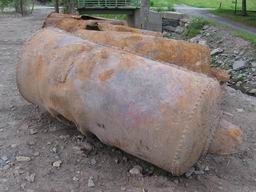
Previously, efforts to divert water around
this bend resulted in the placing of metal cyliners from the old acid
factory along the creek's banks. These cylinders, known as retorts when
the plant was in operation, were used to burn, or rather smolder, off
the four-foot length wood in a process that provided the factory's
finish products.
With the shutting down of the plant, five of
these retorts were lined up on the bank in an effort keep the bank from
eroding and divert the water around the Simpson place. For years they
did the job until the last flood when some of them fell into the creek's
bed. All but one has now been removed from the creek and are set to be
hauled away. One still remains, however, inbeded in the bank as stones
and vegetation are encased around the old tank
**************************.
Shandelee Stories
Sand Pond has had a large number of drowning occur over the years,
a rather large number considering the smallish size of that body of water.
Though most of the drowning were accidental, some were planned in advance.
John Fries' family had its share of tragedy. His younger brother, George,
was killed when his team of horses ran onto the railroad tracks at
Livingston Manor. His young son, William, died from head injuries
sustained when he was struck with a baseball bat. Still, John showed no
emotional effects of these events. What did bother him, though, was when
his team of horses bolted while participating in a coaching-day parade,
running over a child. He was institutionalized for a short period and
thought to have recovered from the traumatic event.
During the summer boarding season at the Chestnut Grove House, in 1908,
the guests had just finished the noon-day meal. John, as usual, helped in
the kitchen and when the serving of the meal was over, handed the items
from his pocket over to his son and told him he was going for a swim at
the lake. His aged father, whom John was now caring for, followed him down
to the lake. John mounted a row-boat, and rowed a short distance from
shore. He paused for a moment, shouted back to his father his intention
and bid him farewell. He then went overboard and slipped into the lake's
water, never to reappear on the surface.
His father scrambled back to the house to acquire help but it was too
late. Dredging and blasts from dynamite were unsuccessful in retrieving
the body. Two weeks later, John's body finally found its way to the lake's
surface.
******************
Shandelee Stories - LakeView
Does anybody know the location of Lakeview Cottage?
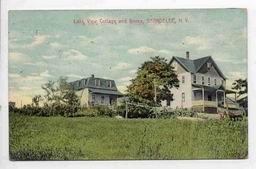
<click for full-size>
I think it was the hotel before the Lake Rest, but I'm
not sure.
Thanks - pgbernasconi
****************************
The question was raised whether the
Shandelee area boarding house shown in the attached postcard, which is
identified as Lake View Cottage, would also be the same Shandelee boarding
house known as Lake Rest Cottage. That probably is not the case. This
image is one that is not in any of the postcard collections that I have
seen and the name of Lake View Cottage was never associated to any of the
known boarding houses on Shandelee, therefore it took a little time and
research in attempting to find its true location.
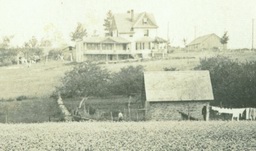
<click for full-size>
This photograph, or rather a portion of a photograph, shows the Lake Rest
Cottage as it appeared around 1910. As it can be seen, the main building
differs from that of the Lake View postcard as does the general landscape;
Lake Rest was located at the top of a rise, overlooking the lake and the
hotel below [Chestnut Grove House]. The landscape around The Lake View, as
shown in the postcard, is of a more gentle, flatter relief.
The building in the foreground is the ice-house for the Chestnut Grove
House.
<click for full-size>
Besides the Lake Rest Cottage, there were four other
boarding house locations on Shandelee that offered a view of the lake,
thus the name Lake View. Three of them were on Shandelee Lake. The
attached photograph shows Shandelee Lake, again around 1910, showing the
three boarding houses on the lake. On the right is the John Breiner hotel,
later known as Rudy's and also as the Shandelee Lake Lodge. Across the
lake in the distance can be seen the Louis Black boarding house, later to
become the Waldemere Hotel, and the Andrew Fries farm, located where
eventually the Waldemere Hotel would erect a golf course. Close
examination of this photograph shows that none of the buildings shown at
these three sites resemble the building in the Lake View postcard.
<click for full-size>
This view of Sand Pond, again taken around 1910, shows the fourth boarding
house that could claim to have a view of the lake. Across the lake and to
the right is the Henry Rose farm and boarding house. It would later become
Camp Livingston, Camp Delmont, Camp Nel-K-Mar and is now the Clearwater
subdivision.
<click for full-size>
A detailed portion of the Sand Pond photograph shows the Henry Rose farm.
As it can be seen, the main building is very similar to that on the Lake
View Cottage postcard; including the chimney, front porch, window
locations and the door on the left side of the building. The building on
the left also resembles the "Annex", with the porch and dormers. Even the
tree in front of the buildings seem to match that on the postcard. My
guess is that the Henry Rose place would be the Lake View Cottage, which
was directly across the lake from the Lake Rest Cottage. -Fred
************************
|